In Summary
An Electrician is involved in the installation, commissioning, testing, and maintenance of various wiring systems and services in domestic, commercial and industrial applications.
Video: Mark Maguire, Electrical Apprentice, Design Group.
The work of an Electrician ranges from wiring of domestic houses, offices and retail units to more complex systems involving instrumentation, process control and maintenance in industrial plants, hospitals and power stations.
Electricians also service, maintain and repair electrical equipment, both domestic and industrial.
View the brochure below to explore other aspects of electrical work and details of the phases in an Electrical Apprenticeship.

Electrical Work and Employment
- Electricians employed by the Electricity Supply Board (ESB) engage in electrical power supply and distribution.
- Electricians employed by electrical contractors are usually engaged in the installation of lighting, heating, and power equipment, and the repair of existing equipment and appliances.
- Those in industrial employment are generally engaged in the maintenance and repair of factory plant, machinery and generating equipment.
Video: Emmett Grogan, Assist Electrical Services Ltd.
View Occupation Profile from Apprenticeship.ie
To view full details of this occupation, view information from our Careers database for the following occupation: Electrical
Entry Requirements
You must have reached a minimum age of 16 years to be employed as an apprentice.
The minimum educational requirements are:
- Grade D or "Achieved" in five subjects in the Department of Education & Skills Junior Certificate Examination or an approved equivalent,
or - The successful completion of an approved Pre-Apprenticeship course,
or - Three years’ work experience gained over sixteen years of age in a relevant designated industrial activity (considered acceptable by SOLAS).
You must obtain a job as an apprentice in your chosen occupation.
Your employer must be approved to train apprentices and must register you as an apprentice within 2 weeks of recruitment.
In this apprenticeship, applicants are required to pass a colour vision test approved by SOLAS.
These are the current approved minimum educational requirements for apprenticeship programmes. However, previous experience of the following subjects would be an advantage, but not essential:
- Mathematics
- Technology
- Technical Drawing/Graphics
- Physics
- Construction Studies
Please note: To become an electrical apprentice, you must pass the Ishihara Colour Vision Test (24 Plate Edition).
For further information, contact your local Education and Training Board .

Training
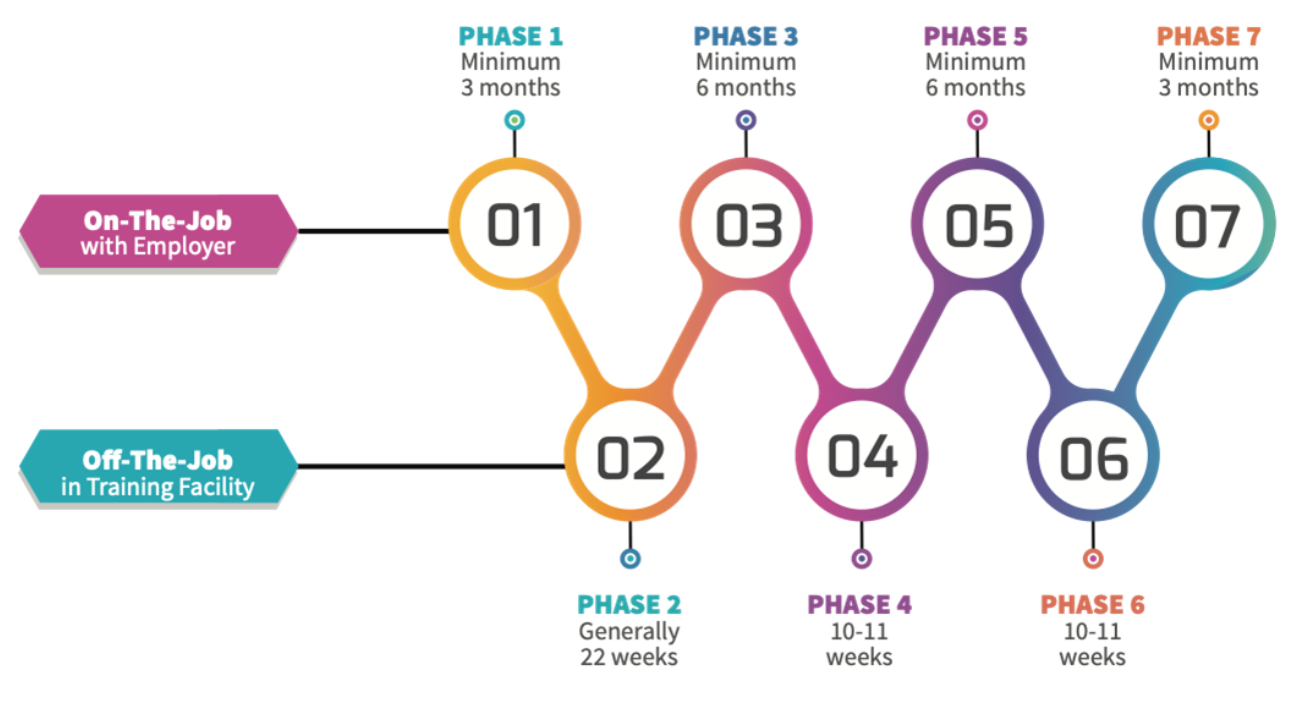
Course Content
Phase 1: With Employer
- Induction Training
- Introduction to Health & Safety
- Introduction to Tools & Equipment
- Introduction to Basic Skills
Phase 2: Delivered in Training Centre (22 weeks)
- Induction Electricity 1
- Installation Techniques 1 (Domestic)
- Installation Techniques 2 (Industrial)
- Panel Wiring and Motor Control
- Related Theory
Phase 3: With Employer
- Work Based Training and Assessments
Phase 4: Delivered in Educational College (11 weeks)
- Electricity 2
- Power Distribution 1
- Electronics 1
- Related Theory
Phase 5: With Employer
- Work Based Training and Assessments
Phase 6: Delivered in Educational College (11 weeks)
- Automation Control
- Access Control and Alarm Systems
- Electricity 3
- Power Distribution 2
- Electronics 2
- Related Theory
Phase 7: With Employer
- Work Based Training and Assessments
The overall duration of this apprenticeship is a minimum of 4 years provided all phases are successfully completed.
On successful completion of the programme, the learner is awarded a Level 6 Advanced Certificate Craft - Electrical.
Training is provided by the following institutions:
- Dundalk Institute of Technology
- TU Dublin - City Campus
- ATU (IT Sligo)
- South East Technological University Waterford (Waterford Institute of Technology)
- TU Dublin - Blanchardstown
- South East Technical University- Carlow campus (IT Carlow)
- City of Dublin Education and Training Board
- Kerry Education and Training Board
- Monaghan Institute
Further information is also available from your local Education and Training Board .
Skills & Qualities
An Electrician is physically active and works with their hands.
Health and safety and good housekeeping are important elements in the work of an electrician.
Attention to detail and an eye for the aesthetic are also essential.
The Electrician must have the ability to:
Plan and organise.
Communicate effectively.
Solve problems.
Work independently and as part of a team.
Show a positive attitude.
Recognise the need for good customer relations.
Demonstrate good work practices including time keeping, tidiness, responsibility, quality awareness, and safety awareness.
Core Skills
- Selection, procurement, safe use of, and storage of craft-related tools, equipment, and materials.
- Selection and utilisation of fixing devices.
- Assessment, interpretation, and implementation of ETCI wiring regulations, installation inspection, and testing procedures.
- Utilisation of electrical test instruments.
- Installation of steel conduit wiring systems, plastic conduit wiring systems, steel trunking cable systems, plastic trunking cable systems, cable tray and ladder systems, industrial cable systems, sub-distribution boards and protective devices.
- Installation and maintenance of lighting, heating, and motive power systems and controls.
- Installation and testing of overcurrent and earth leakage protection systems.
- Installation of earthing and bonding systems.
- Interpretation of circuit schematics and architectural drawings which incorporate IEC symbols, technical data and manufacturing standards, equipment assembly, disassembly, and adjustment procedures.
- Completion and updating of job-related documentation.
View the National Apprenticeship Occupational Profile for more details on the skills of the craft.
Work Activities
- Learn and develop new practical craft-related skills, knowledge and competence.
- Work with and learn from professionals who are experienced in the craft.
- See a job through from start to finish.
- Comply with Health and Safety requirements.
- Understand and use physics.
- Work with electricity or electronics.
- Be accurate with numbers in counting, measuring, and arithmetic.
- Complete detailed tasks that require accuracy and careful handling.
- Work with technical drawings and diagrams.
- Work with a variety of specialised hand tools, power tools, and equipment.
- Be well organised and careful with practical tasks.
- Lift or carry heavy items.
- Take responsibility for your own learning and the allocation of study time.
- Be physically active (frequent bending and kneeling).
- Pass all your phase exams (theory, practical skills, demonstration).
- Earn as you learn.
Career Progression
On successful completion of the apprenticeship programme, apprentices are qualified to work within the recognised trade or profession.
Opportunities can arise for promotion to supervisor level.
Many use their qualification to start careers in engineering, management, business, teaching, or training.
Following successful completion of your Electrical Apprenticeship you can get an exemption from Year 1 of a Level 8 Electrical Engineering Degree.
The trade skills are transferable across industry sectors and are highly valued internationally.
For top-level apprentices with a desire to advance, potential career progression routes include:
- Site Supervisor
- Project Manager
- Contracts Manager
For those with entrepreneurial flair, setting up a business may be a desirable next step.
| Did you know ... Qualified Electricians who have successfully completed their Apprenticeship can immediately earn up to €43,000 per annum. There is a significant demand for Electricians across the Pharmaceutical and Technology sectors. Companies in these areas employ large numbers of Electricians. |
Advancement and Promotion
Where apprentices and crafts persons have the necessary ability, initiative, and basic qualifications, opportunities are available for advancement.
- These include advanced technological and management courses available in institutes of technology, schools of management, professional institutes, etc.
- People in employment have a number of options for both Educational and Career Progression. It might also be possible to gain promotion within your existing company.
- By using your existing qualifications and experience you may be able to secure an alternative position in a more senior role in another company.
- It may also be possible to set up your own company based again on your existing qualifications and experience.
Whatever route you decide to take, remember education is a lifelong pursuit and you can always continue to upskill and/or retrain, whatever your age.
Career Progression Useful Links:
Educational Supports:
On completion of an apprenticeship your educational progression options may be offered as full awards on the NFQ levels 7-10 National Framework . You may also decide to embark on a partial award or to up skill in a particular area by undertaking a short specialised course. Depending on your skills, knowledge, and experience, some of the opportunities below may be appropriate to help develop your career pathway.
- Springboard & conversion courses
- Skillnet Sector learning network courses
- Skill to advance Local ETB Board
- Further education training centres Fetchcourses
- Post graduate education Search Post Graduate options
Enterprise and Self-Employment Support:
If you wish to set up your own business after completing your apprenticeship, the links below may be useful.
- Local Enterprise Offices , For profit Local enterprise support
- Local Area partnerships For profit enterprise support
- Social entrepreneurs : Not-for-profit enterprise support
- Franchising : Developing your business under an established franchise
Getting this Apprenticeship
Steps:
- Secure a contract with an employer.
- Apply directly to an employer rather than the training provider.
- Once you have found an employer to take you on as an apprentice, your employer must then register you as an apprentice with SOLAS.
- The employer must be approved to train apprentices.
- The employer must register you as an apprentice within two weeks of recruitment.
To find an apprenticeship, search apprenticeship vacancies and a list of currently approved apprentice employers on the Apprenticeship Jobs & Employers Portal . You can search for vacancies by location, and employers in each apprenticeship.
Use this link to explore a list of Approved Employers by Region and Apprenticeship.
Opportunities
Electrical Apprenticeship opportunities are offered throughout the year. To secure an apprenticeship contract of employment, apply directly to companies where you would like to complete your apprenticeship.

Colour vision requirements
Electrical Apprenticeship applicants are required to pass a colour vision test approved by SOLAS.
Finding an Employer
Finding an employer or registering your interest with an official Coordinating Provider is one of the first things you need to do to start an apprenticeship.
To find an apprenticeship and secure an apprenticeship work contract you can search apprenticeship vacancies on the Apprenticeship Jobs Portal . You can search for vacancies by location and by apprenticeship type.
Your local Education and Training Board may also hold details of employers seeking to employ an apprentice.
You should also directly connect with local employers who might be interested in taking on an apprentice. It is a great idea to get a part time job with a local employer who might be more inclined to take you on as an apprentice following a successful work experience placement or a part time job contract.
Further information about this apprenticeship may be available from the following organisations on this website:
Organisations supporting this apprenticeship
Where we know of supporting organisations we list these below:
Online Job Sites
Here are some direct links to employment websites that frequently list apprenticeship vacancies.
Note: These websites may include vacancies that are not QQI accredited Apprenticeships.






Pay & Fees
As an apprentice, you earn while you learn.
Employment Salary (On-the-job)
The employer pays you a salary while you are being trained on-the-job. The rate of pay is agreed between you and your employer.
Training Allowance (Off-the-job)
A training allowance is paid by the local Education and Training Board (ETB) while you are attending the off-the-job training. In some cases, a contribution towards travel or accommodation costs may be paid.
The employer's sector will determine the allowance payable. These allowances are calculated on the gross wages paid by industry in each sector. The weekly gross wage norms in electrical contracting are listed below.
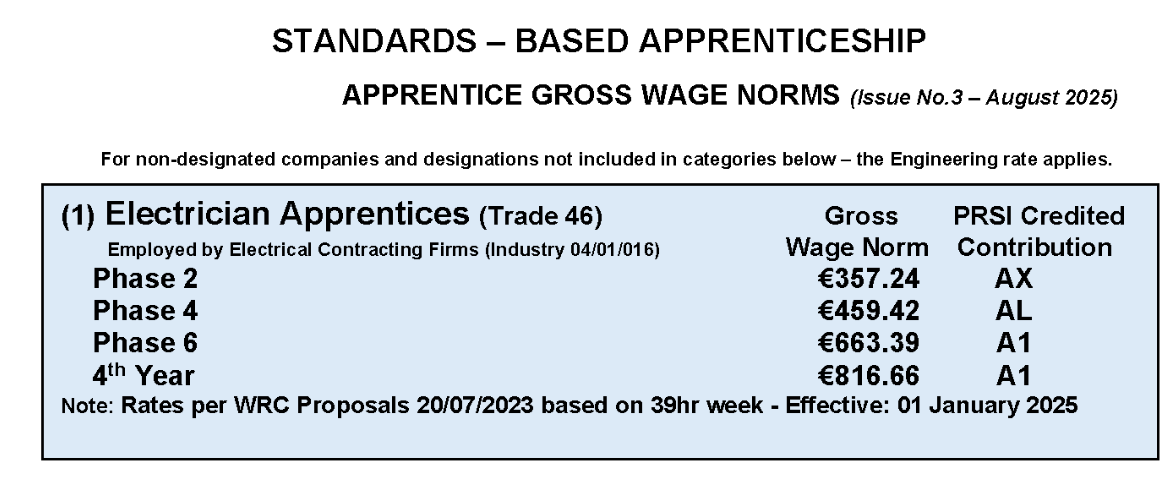
View more details on rates of pay at Connect Trade Union.
(Connect is the largest trade union representing construction, electrical, and technical workers in Ireland.)
View rates of pay for other industries here.
View Information on taxation for off-the-job payments here.
For information on how to access payslips via PEOPLEXD, see out the Apprentice Payee PeopleXD for Payees User Reference Guide .
FEES
Apprentices complete two of their three phases of off-the-job training in a higher education institution. A student contribution must be paid for this part of the training.
The amount of the student contribution is a proportion of the annual student contribution paid by students who are attending a full-time course in higher education. The student contribution is paid directly to the higher education institution.
The student contribution for this apprenticeship is €1,000 for Phase 4 and €1,000 for Phase 6.