In Summary
Painters and Decorators apply paint coatings, wall coverings, and other materials to internal and external surfaces for decorative and preservation purposes. This work may be carried out on walls or surfaces in private dwellings, commercial/industrial locations, or other structures.
Fergal Feehely, Qualified Painter & Decorator, Fergal Feehely Ltd.
The work of a painter and decorator involves applying wall coverings and decorative paint coatings in homes, as well as in commercial and industrial settings. It may also involve designing and producing signage and displays, and providing advice on colour selection and interior design. Painters and decorators are typically employed by building or painting contractors, although many are self-employed.

Click on the image above to view The Craft of Painting & Decorating brochure.
View Occupation Profile from Apprenticeship.ie
To view full details of this occupation, view information from our Careers database for the following occupation: Painter / Decorator
Entry Requirements
The minimum age at which an apprentice may commence employment is 16 years.
The minimum educational requirements are:
Grade D or "Achieved" in five subjects in the Department of Education & Skills Junior Certificate Examination or an approved equivalent,
or
The successful completion of an approved Pre-Apprenticeship course,
or
Three years’ work experience gained over sixteen years of age in a relevant designated industrial activity as SOLAS shall deem acceptable.
You must obtain a job as an apprentice in your chosen occupation. Your employer must be approved to train apprentices and must register you as an apprentice within two weeks of recruitment.
Note: These are the current approved minimum educational requirements for apprenticeship programmes. However, previous experience in the following subjects would be an advantage, though not essential:
- Art
- Technical Drawing/Graphics
- Construction Studies
- Technology
Note: Colour vision testing and a pass result are no longer a mandatory requirement for entry to this apprenticeship.
Instead, it is recommended that employers require that all candidates for the above apprenticeships complete a colour vision screening by an optometrist before registration. This is to make both the candidate and the employer aware of any colour vision issues that may be present.
For those who do not pass the initial test, further testing is recommended at the National Optometry Centre. This test will provide the employer and the apprentice applicant with key information which will further aid awareness of the type and grade of theColor Vision Deficiency (CVD) present.
This will support the employer to have reasonable accommodation conversations with the apprentice and support a more inclusive workplace for people with CVD.
For further information, contact your local Education and Training Board .
Training
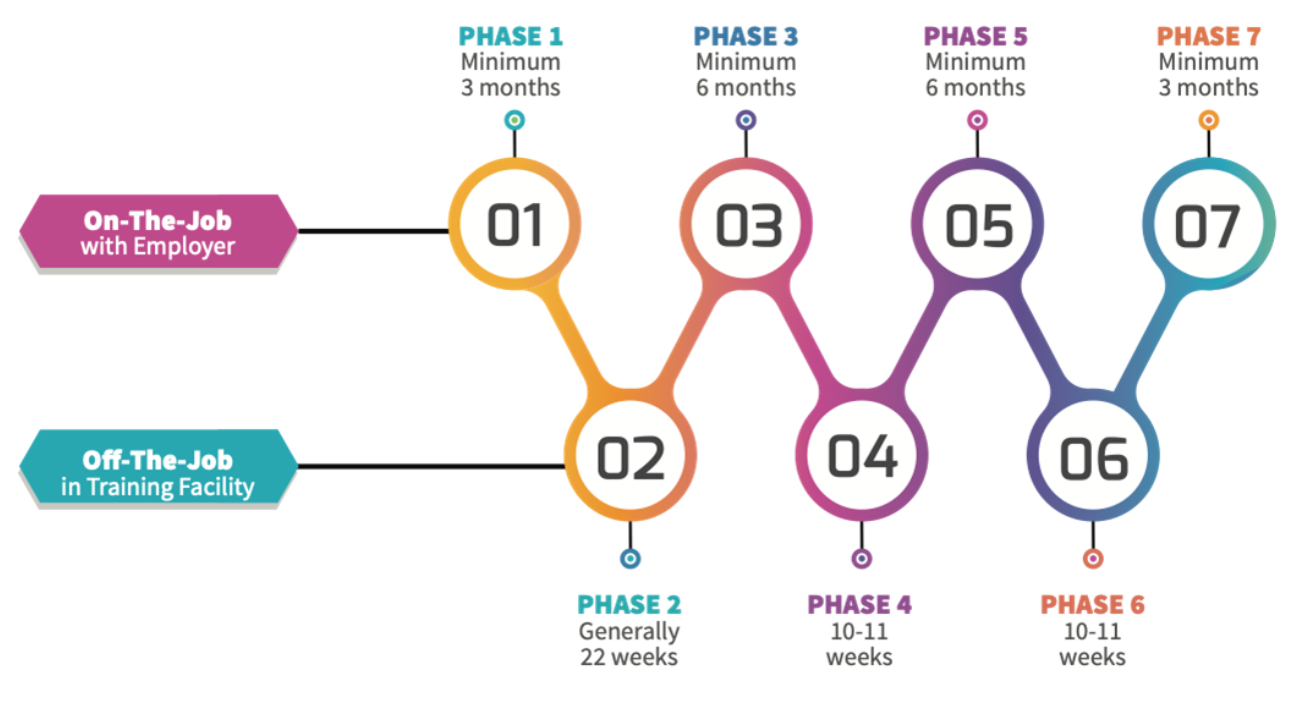
Phase 1: With Employer
- Induction Training
- Introduction to Health & Safety
- Introduction to Tools & Equipment
- Introduction to Basic Skills
Phase 2: Delivered in Training Centre (20 weeks)
- Induction
- Recoating Surfaces & Signwork
- Surface Preparation
- Imitative & Decorative Arts
- Wallcoverings
Phase 3: With Employer
- Work Based Training and Assessments
Phase 4: Delivered in Educational Colleges (10 weeks)
Course Content:
- Signwork
- Wallcoverings
- Imitative & Decorative Arts
- Paint Spraying & Equipment
Phase 5: With Employer
- Work Based Training and Assessments
Phase 6: Delivered in Educational Colleges (10 weeks)
Course Content:
- Airless Spraying
- Signwork
- Imitative & Decorative Arts
- Wallcoverings
Phase 7: With Employer
- Work Based Training and Assessments
The overall duration of this apprenticeship is a minimum of four years provided all phases are successfully completed.
On successful completion of the programme, the learner is awarded a Level 6 Advanced Certificate Craft – Painting & Decorating.
The training is provided by the following institutions:
- TU Dublin – Bolton Street (Linenhall)
- City of Dublin Education and Training Board
- Waterford Wexford ETB
This list is not exhaustive.
Further information on training is available from your local Education and Training Board .
Skills & Qualities
As a painter and decorator, you need to be physically fit and comfortable working at heights.
An awareness of health and safety, along with good housekeeping practices, is essential. Attention to detail and a good eye for shape and design are also important qualities.
A painter and decorator must have the ability to:
- Plan and organise work
- Communicate effectively
- Solve problems
- Work independently and as part of a team
- Show a positive attitude
- Understand the importance of good customer relations
- Demonstrate good work practices, including punctuality, tidiness, responsibility, quality awareness, and safety awareness
Occupational Hazard:
If you suffer from allergies or skin conditions, the chemicals used in paints and other materials may affect you.
Work Activities
Painters and Decorators require a wide range of skills, including:
- Working with a variety of specialised hand and power tools
- Understanding how colours, textures, and shapes are used in design
- Knowledge of renovation, preservation, and restoration techniques
- Performing a range of painting techniques
- Applying wall coverings in a variety of settings
- Designing and producing signage and displays
- Advising clients on colour selection and interior design
Aspects of the Work:
- Learning and developing new practical craft-related skills, knowledge, and competence
- Working with and learning from experienced craftspeople
- Seeing projects through from start to finish
- Complying with health and safety requirements
- Working both indoors and outdoors
- Measuring and calculating quantities and areas with accuracy and attention to detail
- Being well-organised and careful with practical tasks
- Working at heights
- Lifting or carrying heavy items
- Taking responsibility for your own learning, including managing study time
- Working in a variety of locations – residential homes, industrial units, or commercial properties
- Being physically active
- Passing all phase exams (theory and practical skills demonstrations)
- Earning while you learn
Career Progression
On successful completion of the apprenticeship programme, apprentices are qualified to work within the recognised trade or profession.
Where apprentices and craftspeople have the necessary ability, initiative, and basic qualifications, there are various opportunities for advancement. These may include advanced technology or management courses offered by technological universities, colleges, and professional bodies.
People already in employment have several options for both educational and career progression.
These may include:
- Gaining promotion within your current company
- Using your qualifications and experience to secure a more senior position with another employer
Starting your own business, based on your skills, qualifications, and experience, is also a potential progression route.
Whatever path you choose, remember that education is a lifelong journey. You can always continue to upskill or retrain at any stage of your life.
Useful links to educational and enterprise supports are provided below.
Career Progression Useful Links
Educational Supports:
On completion of an apprenticeship, you may be eligible to pursue further education leading to full awards on the National Framework of Qualifications (NFQ) at Levels 7 to 10.
Alternatively, you may choose to undertake a partial award or focus on upskilling in a specific area by completing a short, specialised course.
Depending on your skills, knowledge, and experience, some of the links listed below may be suitable for supporting and developing your career pathway.
- Springboard & conversion courses
- Skillnet learning network courses
- Skills to advance at your local ETB
- Further education and training Fetchcourses
- Post graduate education – Post Graduate options
Enterprise and Self-Employment Support
If you feel you have the appropriate knowledge, skills, and experience, you may choose to set up your own business. The links below may be useful in supporting you on this journey:
- Local Enterprise Offices For profit Local enterprise support
- Local Area partnerships For profit enterprise support
- Social entrepreneurs Not-for-profit enterprise support
- Franchising Developing your business under an established franchise
Getting this Apprenticeship
In order to secure an apprenticeship, you must first secure a contract with an employer. You must apply directly to an employer rather than the training provider. Once you have found an employer to take you on as an apprentice, your employer must then register you as an apprentice with SOLAS .
- The employer must be approved to train apprentices.
- The employer must register you as an apprentice within two weeks of recruitment.
Opportunities for this apprenticeship arise throughout the year.
To secure an apprenticeship contract of employment, you should identify and target companies you are interested in and apply to them directly.
To find an apprenticeship, you can search for current vacancies and view a list of approved apprentice employers on the Apprenticeship Jobs & Employers Portal . The portal allows you to search by location and by employer within each apprenticeship trade.
View Approved Employers by Region and by Apprenticeship Type here
Search training available at your local ETB by selecting your county here
Finding an Employer
Finding an employer or registering your interest with an official Coordinating Provider is one of the first things you need to do to start an apprenticeship.
To find an apprenticeship and secure an apprenticeship work contract you can search apprenticeship vacancies on the Apprenticeship Jobs Portal . You can search for vacancies by location and by apprenticeship type.
Your local Education and Training Board may also hold details of employers seeking to employ an apprentice.
You should also directly connect with local employers who might be interested in taking on an apprentice. It is a great idea to get a part time job with a local employer who might be more inclined to take you on as an apprentice following a successful work experience placement or a part time job contract.
Further information about this apprenticeship may be available from the following organisations on this website:
Online Job Sites
Here are some direct links to employment websites that frequently list apprenticeship vacancies.
Note: These websites may include vacancies that are not QQI accredited Apprenticeships.






Pay & Fees
As an apprentice, you earn while you learn.
Employment Salary (On-the-job)
The employer pays you a salary while you are being trained on-the-job. The rate of pay is agreed between you and your employer.
Training Allowance (Off-the-job)
A training allowance is paid by the local Education and Training Board (ETB) while you are attending the off-the-job training. In some cases, a contribution towards travel or accommodation costs may be paid.
The sector the apprentice's employer is engaged in will determine the allowance payable. These allowances are calculated on the gross wages paid by industry in each sector. The hourly rates and weekly gross wage norms for the construction industry are listed below.
Apprenticeship Gross Wage Norms
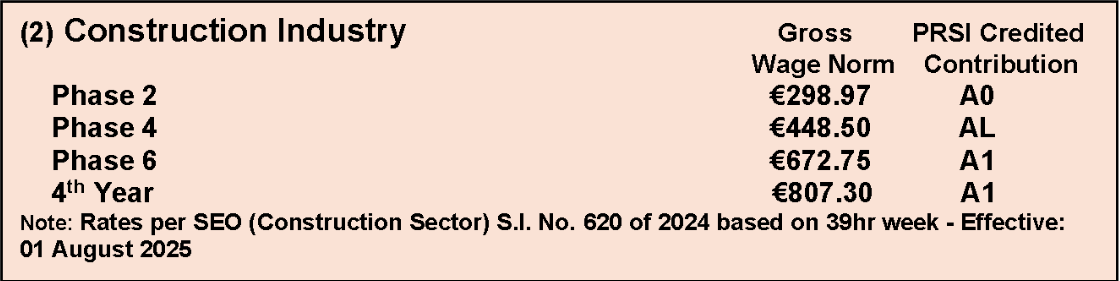
View more Information on off-the-job payments here
View details on rates of pay at Connect Trade Union
(Connect is the largest trade union representing construction, electrical, and technical workers in Ireland.)
Apprentice Hourly Rates of Pay in the Construction Industry
(Per Construction SEO Order SI 620 of 2024)
From 1st August 2025 to 31st July 2026
- 1st Year. 33.33%. €7.67
- 2nd year. 50%. €11.50
- 3rd Year. 75%. €17.25
- 4th Year. 90%. €20.70
From 1st August 2026
- 1st Year. 33.33%. €7.91
- 2nd year. 50%. €11.87
- 3rd Year. 75%. €17.81
- 4th Year. 90% €21.37
View more details on industry rates of pay at Connect Trade Union
For information on how to access payslips via PEOPLEXD, see out the Apprentice Payee PeopleXD for Payees User Reference Guide .
FEES
Apprentices complete two of their three phases of off-the-job training in a higher education institution. A student contribution must be paid for this part of the training.
The amount of the student contribution is a proportion of the annual student contribution paid by students who are attending a full-time course in higher education. The student contribution is paid directly to the higher education institution.
The student contribution for this apprenticeship is €1,000 for Phase 4 and &