In Summary


Commis Chef Apprenticeship Overview
The Commis Chef Apprenticeship is designed for aspiring chefs who have a strong interest in cooking and a creative flair for culinary arts. Like any career choice, it's important to understand the role of a professional chef before committing. The best ways to do this include:
- Talking to professional chefs about their experiences.
- Gaining hands-on experience in a professional kitchen to understand daily responsibilities.
Purpose of the Commis Chef Apprenticeship
The apprenticeship serves as the starting point for a career as a professional chef. It provides a two-year formal education and training programme for young chefs across Ireland to begin their culinary careers.
This programme is open to:
- Young people aged 16 and over
- Existing kitchen staff
- Anyone seeking an internationally recognised culinary qualification
Training and Skills Development
Training to become a Commis Chef focuses on developing the knowledge, skills, and competence to perform core cooking tasks within a kitchen. Apprentices are trained to work autonomously at the Commis Chef level.
The programme combines:
- Off-the-job training - classroom-based learning in a college or training centre
- Work-based training - practical, on-the-job experience in an approved hotel or restaurant kitchen
Qualification and Career Progression
Upon successful completion, apprentices will receive:
- QQI Level 6 Major Award - Advanced Certificate in Culinary Arts
Graduates are also eligible to progress to the Chef de Partie Apprenticeship at QQI Level 7, further advancing their culinary career.
Becoming a Commis Chef Apprentice
To enter the apprenticeship:
- You must obtain employment in a SOLAS-approved hotel or restaurant kitchen.
- Your employer must register you as an apprentice within two weeks of recruitment.
 Apprentice Commis Chef Applicant Guide
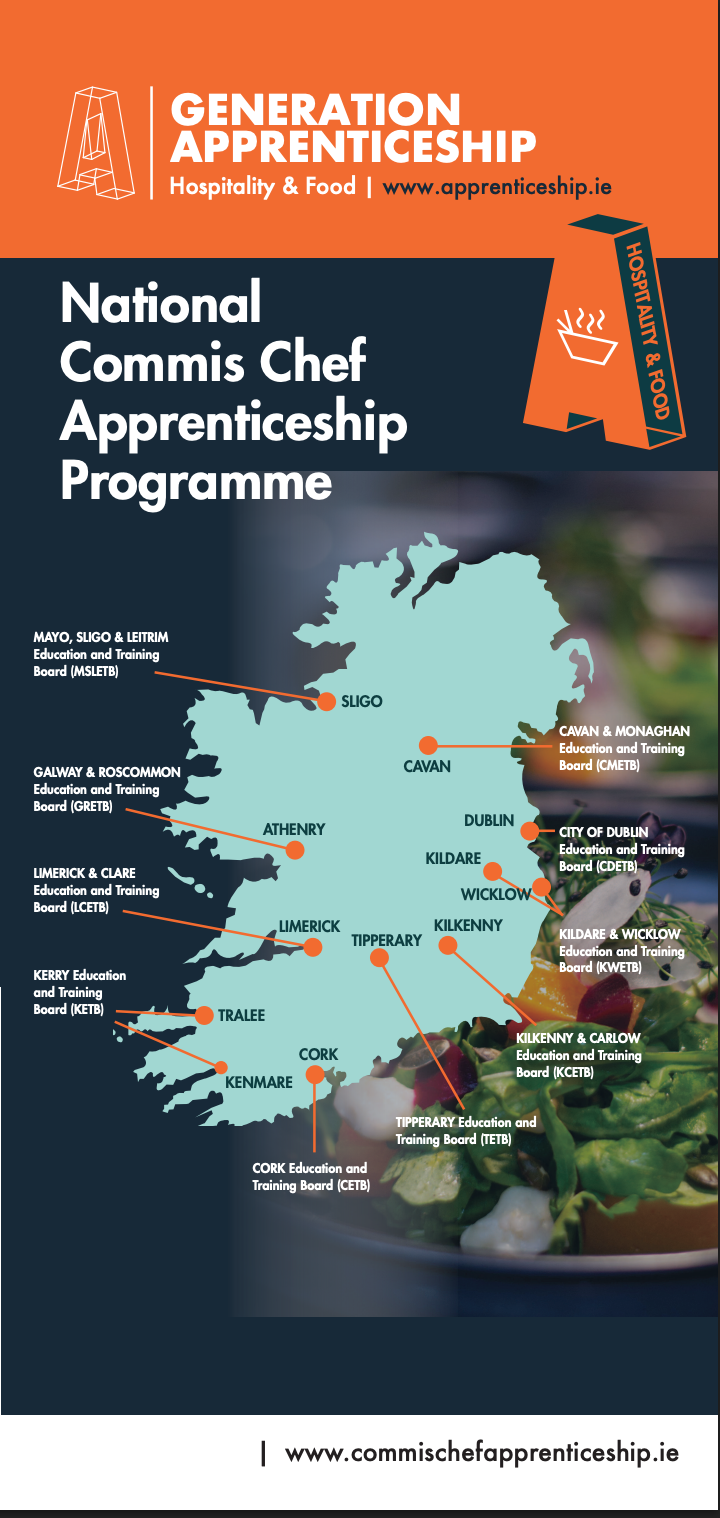 Click on the image to view the National Commis Chef Apprenticeship Brochure.
For more details, visit the dedicated National Commis Chef Apprenticeship Programme web page here .
View Occupation Profile from Apprenticeship.ie
To view full details of this occupation, view information from our Careers database for the following occupation: Commis Chef
Entry Requirements
Before applying to this apprenticeship, please check that you meet all entry requirements.
The minimum age at which the employment of an apprentice may commence is 16 years of age.
The minimum education requirements are:
- a qualification placed at Level 4 of the National Framework of Qualifications (a Pass Leaving Certificate), OR
- have at least three years trade related experience.
Applicants should have minimum requirements relating to general learning; including speaking, listening and communication skills, and self-organisation skills.
The following qualifications will be accepted as indicating that these general learning requirements have been met:
- A qualification placed at Level 4 of the National Framework of Qualifications Framework.
- A minimum of 5 passes in a certificate placed at EQF Level 3 for holders of EU qualifications.
- A minimum English language competency of B2 in writing, reading, listening and speaking on the Common European Framework of Reference for Languages (CEFRL) is required at entry to the programme for speakers of English as a second or other language.
Certification
Upon successful completion, the newly qualified Commis Chef will receive a QQI Level 6 Major Award - Advanced Certificate in Culinary Arts.
Training
In advance of completing an application for the Commis Chef Apprenticeship it is important to understand the commitment you will need to provide to this programme.
Programme Structure
Apprentices will be trained in a progressive manner under the watchful eye of a professionally qualified Chef Instructor. A blend of Off The Job and On The Job Training applies for 2 years as apprentices Earn While They Learn.
- Initial 3 week block release of intensive, structured learning in an ETB training centre (15 days)
- 2 days per week in ETB training kitchen, 3 days with Employer (2 years)
- July and August: 1 day with ETB, 4 days with Employer (2 years)
Apprentices will spend over 65% of their time with their SOLAS approved employer, being supported at all times by a dedicated and trained Workplace Mentor. Mentors shadow, coach, observe and guide the apprentice.
Year 1 consists of:
- 3 weeks of intensive structured learning in a college or centre.
- 2 days per week in a college or centre and 3 days per week working with a SOLAS approved employer from October to June.
- 1 day per week in a college or centre and 4 days per week working with a SOLAS approved employer for July and August.
Year 2 consists of:
- 2 days per week in a college or centre and 3 days per week working with a SOLAS approved employer from September to June.
- 1 day per week in a college or centre and 4 days per week working with a SOLAS approved employer for July and August.

The training is provided by the following list of institutions:
- Cavan/Monaghan ETB Cavan Institute
- Cork ETB Westside Centre
- Crumlin College of Further Education
- Colaiste Ide College of Further Education
- Galway/Roscommon ETB
- Kerry ETB, Kerry College of Further Education
- Limerick ETB, Hospitality Education & Training Centre
- Kilkenny/Carlow ETB
- Kildare/Wicklow ETB
- Mayo/Sligo/Leitrim ETB
- City of Dublin ETB
Skills & Qualities
Is this program right for you?
Typical qualities found in learners who are pursuing a career in Professional Cookery include:
- Genuine passion for food
- Enjoy working with a team
- Can plan and work efficiently
- Creativity
Is the Commis Chef Apprenticeship for me?
The Commis Chef Apprenticeship is aimed at aspiring chefs who have a keen interest in and a creative flair for cooking. Apprentices will possess the following attributes:
- Genuine interest in food and latest food trends.
- Ability to listen, take instruction and ask questions.
- Enjoy high energy pace of work.
- Good literacy, verbal and numeracy skills.
- Ability to plan and prepare work.
- Good hand/eye co-ordination and manual dexterity.
- Enjoy engaging with others throughout the working day.
- Appreciate creativity.
- Ability to work independently and as part of a team.
On successful completion, the Commis Chef will be able to identify/recognise/understand:
- The factors which influence the types of dishes and menus offered by the business.
- How technology supports the development and production of dishes and menu items in own kitchen.
- The importance of checking food stocks and managing stock rotation.
- The setup, preparation and cleaning tasks to the agreed standard whilst working in a challenging environment (in compliance with food safety legislation).
- The correct ingredients and portion sizes for each dish in line with recipe specifications.
- The principles of basic food preparation and cooking; taste; allergens; diet and nutrition.
- Commonly used knives and kitchen equipment and their specific function.
- Sources and quality points of common food groups and commodities.
- Traditional cuts of and basic preparation methods for, meat, poultry, fish and vegetables.
- The impact of seasonality on the availability, quality and price of ingredients.
Food Safety:
- Identify the personal hygiene standards, food safety practices and procedures required in compliance with food safety legislation.
- Understand how to store, prepare and cook ingredients to maintain quality, in line with food safety legislation.
People:
- Understand how personal and team performance impact on the successful production of dishes and menu items.
- Know how to communicate with colleagues and team members from a diverse range of backgrounds and cultures.
- Understand the importance of training and development to maximise own performance.
- Know how to support team members when the need arises.
- Have an understanding of professional behaviours and organisational culture.
- Recognise how all teams are dependent on each other and understand the importance of teamwork both back and front of house.
Business:
- Understand the basic costing and yield of dishes and the meaning of gross profit
- Understand the principles of supply chain and waste management
- Recognise potential risks in the working environment, how to address them and the potential consequences of those risks
- Demonstrate a specialist knowledge of hospitality business principles and practices including application within an entrepreneurial context
Competencies
Culinary:
- Show enthusiasm for keeping up to date with business and current industry trends.
- Use information communication technology and equipment in line with hospitality training.
- Demonstrate the knowledge and understanding of stock rotation and stock control.
- Demonstrate the ability to identify when tasks are not going to plan and have the confidence to request support when needed through the mentoring system.
- Work consistently to achieve standards within the hospitality environment.
- Show commitment to developing skills and knowledge; trying out new ingredients and dishes; practising and reflecting on different preparation and cooking techniques.
- Demonstrate care and attention when using knives and equipment in conjunction with health and safety regulation.
- Consistently use the correct volume and quality of commodities in each dish, maintaining attention to detail.
- Utilise the correct cuts and preparation methods in the production of high quality, safe and wholesome dishes/food for consumption.
- Develop an understanding and appreciation of food ingredients.
Food Safety:
- Demonstrate excellence personal hygiene standards in conjunction with food safety legislation.
- Demonstrate safe working practices when storing, preparing and cooking ingredients in order to maintain quality and ensure food safety.
People:
- Apply a professional approach to all tasks within the role.
- Listen and understand other peoples’ point of view and respond courteously.
- Acknowledge and recognise teams achievement through positive feedback recognising peoples work and commitment.
- Work positively as a team member.
- Apply and understand the business culture and values.
- Communicate and behave effectively to help team members achieve the best result for the customers and the business.
Business:
- Be financially aware of the cost implications through the business in approach to all aspects of work.
- Apply good waste management practices within the business.
- Be aware of potential risks within the kitchen environment and takes action to prevent them.
Work Activities
A Commis Chef carries out the core cooking tasks/responsibilities within the kitchen section of a restaurant, hotel, catering facility (e.g. starters, vegetables, sweets, meats, sauces, etc.). The Commis Chef works autonomously at this level.
Culinary:
• Contribute to reviewing and refreshing menus in line with business and customer requirements
• Use available technology in line with business procedures and guidelines to achieve the best result
• Check food stocks, report on shortages, prioritise food that is close to expiry and keep the storage areas in good order
• Work methodically to prioritise tasks, ensuring they are completed at the right moment and to the required standard
• Measure dish ingredients and portion sizes accurately
• Demonstrate a range of craft preparation and basic cooking skills and techniques to prepare, produce and present dishes and menu items in line with business requirements
• Use correct knives and knife skills when preparing food and use the correct equipment when preparing, cooking and presenting food
• Correctly store and use food commodities when preparing dishes
• Apply correct preparation and selection methods when using meat, poultry, fish and vegetables in dishes
• Complete preparation and cooking tasks to a high standard, delivered on time and presented as described within the recipe specification
Food Safety:
• Maintain a clean and hygienic kitchen environment at all times, complete kitchen documentation as required in compliance with food Hygiene requirements
• Store, prepare and cook ingredients correctly to deliver a quality product that is safe for the consumer in compliance with Food Safety regulation
Career Progression
On successful completion of the apprenticeship programme, newly qualified Commis Chefs will receive a QQI Level 6 Major Award - Advanced Certificate in Culinary Arts. They will also be eligible to progress to the Chef de Partie Apprenticeship at QQI level 7.
Note: People in employment have a number of options for both Educational and Career Progression. It might also be possible to gain promotion within your existing company.
By using your existing qualifications and your experience you might to able to secure an alternative position in a more senior role in another company. It may also be possible to set up your own company based again on your existing qualifications and experience. Whatever route you decide to take remember education is a lifelong pursuit and you can always continue to up skill and/or retrain, whatever your age. Links to some educational and enterprise supports can be found below.
Commis Chef (Level 6), Chef de Partie (Level6/7), Sous Chef (Level 7/8), Head Chef (Level 7/8), Executive (Level 9), Food Product Development Chef (Levels 6/7/8). - Candidates who have successfully completed a relevant award at Level 5 can apply for entry into this system. candidates who successfully complete each level will be eligible to progress to the next level with appropriate relevant work experience.
Career Progression Useful Links:
On completion of an apprenticeship your educational progression options may be offered as full awards on the NFQ levels 7-10 National Framework . You may also decide to embark on a partial award or to up skill in a particular area by undertaking a short specialised course. Depending on your skills, knowledge and experience some of the opportunities below might be appropriate to help develop your Career pathway.
- Springboard & conversion courses
- Skillnet Sector learning network courses
- Skills to Advance with Local ETB Board
- Further education training centres
- Post graduate education options
Enterprise and Self-Employment Support:
On completion of an apprenticeship if you feel you have the appropriate knowledge, skills and experience you may decide to set up your own business. The links below might be useful to support you:
- Local Enterprise Offices For profit Local enterprise support
- Local Area partnerships For profit enterprise support
- Social entrepreneurs Not-for-profit enterprise support
- Franchising Developing your business under an established franchise
Getting this Apprenticeship
To become an apprentice, you must obtain employment in a SOLAS approved professional kitchen (i.e hotel, restaurant, catering). The employer must be approved by SOLAS to train apprentices and must register you as an apprentice.
The apprentice’s terms and conditions of employment are agreed between each apprentice and their SOLAS approved employer.
This apprenticeship is managed and supported by the Irish Hotels Federation, the Restaurants Association of Ireland and Failte Ireland. If you are interested in a Commis Chef Apprenticeship you should contact Kerry ETB Training Centre via the contact details below.
The apprenticeship is coordinated by Kerry Education and Training Board and is delivered in a range of locations in Cavan & Monaghan ETB, City of Dublin ETB, Cork ETB, Galway & Roscommon ETB, Kerry ETB, and Limerick & Clare ETB, Mayo, Sligo and Leitrim ETB.
Full eligibility criteria for this apprenticeship are available in the applicant Guide
Recruitment will be through local employers advertising their positions.
To find an apprenticeship, you can search apprenticeship vacancies and a list of currently approved apprentice employers on the Apprenticeship Jobs & Employers Portal. You can search for vacancies by location, and employers in each apprenticeship.
Use this link to explore a list of Approved Employers by Region and by Apprenticeship type.
This apprenticeship is managed and supported by the Irish Hotels Federation, the Restaurants Association of Ireland and Failte Ireland. If you are interested in a Commis Chef Apprenticeship you should contact Kerry ETB Training Centre.
Visit the National Commis Chef Apprenticeship Programme here for further information on how to become an Apprentice Commis Chef.
Further information is also available from the co-ordinating provider for this apprenticeship:
Mallory Higgins
National Apprenticeship Programme Coordinator
Kerry Education and Training Board
Kerry College
Monavalley Campus
Monavalley Industrial Estate
Tralee
Co. Kerry
Tel: + 353 (0) 66 714 9600
Email: [email protected]
Web: www.commischefapprenticeship.ie
Finding an Employer
Finding an employer or registering your interest with an official Coordinating Provider is one of the first things you need to do to start an apprenticeship.
To find an apprenticeship and secure an apprenticeship work contract you can search apprenticeship vacancies on the Apprenticeship Jobs Portal . You can search for vacancies by location and by apprenticeship type.
Your local Education and Training Board may also hold details of employers seeking to employ an apprentice.
You should also directly connect with local employers who might be interested in taking on an apprentice. It is a great idea to get a part time job with a local employer who might be more inclined to take you on as an apprentice following a successful work experience placement or a part time job contract.
Organisations supporting this apprenticeship
Where we know of supporting organisations we list these below:
Online Job Sites
Here are some direct links to employment websites that frequently list apprenticeship vacancies.
Note: These websites may include vacancies that are not QQI accredited Apprenticeships.






Pay & Fees
Apprentices are not required to pay a student contribution for this apprenticeship.
An apprentice is an employee under a full time contract of employment with all the statutory entitlements and protections under employment legislation.
As with any employee the rate of pay is agreed between the employer and the apprentice, but must be at least the national minimum wage rate (and not the training rate). The apprentice’s salary and/or wages is paid by the employer for both on and off the job.