In Summary
This three-year programme leads to a level 7 Bachelor of Science in Polymer Technology from Athlone Institute of Technology. You’ll learn the skills, knowledge and behaviours necessary for a successful career in polymer & plastics processing and beyond. You’ll also earn a salary as you study – so what are you waiting for?.
The Polymer Processing Technologist will be responsible for the efficient set up and operation of polymer processing lines in the fields of injection moulding, blow moulding or extrusion for the production of plastic components relevant to industry standards.
This is a three year apprenticeship programme with an approved employer. 70% of the time is spent on the job and the remaining 30% is spent in the allocated University/ Institute of technology.
The programme leads to a Level 7 QQI Bachelor of Science in Polymer Technology.
To view brochure, click here.
- Employer Handbook, Click here.
- Why Should you hire a Polymer Apprentice? - Click here.
- To find out how to get involved, Click here.
View Occupation Profile from Apprenticeship.ie
To view full details of this occupation, view information from our Careers database for the following occupation: Polymer Processing Technology
Entry Requirements
Entry Requirements for Irish Leaving Certificate Applicants (From August 2017)
Applicants must have obtained a minimum of 5 O6 grades in their Leaving Certificate examination results.
These subjects must include;
- Mathematics (Minimum: H7, O6, F2)
- English or Irish (Minimum: O6, H7)
Entry Requirements for Irish Leaving Certificate Applicants (Prior to August 2017)
The grades of applicants who completed the Leaving Certificate pre-2017 can be mapped directly to a grade on the new grading scale. This mapping exercise for such applicants should be completed so that the entry requirements outlined above can be applied. The grades to be awarded from 2017 for pre-2017 Leaving Certificate grades are set out in the table below1.
1 Table taken from New Leaving Certificate Grading Scale and Revised Common Points Scale to be found at http://www.transition.ie/files/2015/FullDetails-RevisedCommonPointsScale.pdf
QQI-FET Applicants B.Sc. in Polymer Processing Technology (Apprenticeship)
Any cognate QQI-FET level 5 qualification may be deemed acceptable to gain entry to the programme. Applicants to the programme are also required to have the module Mathematics for Engineering (5N1833) included in their award or alternatively have the required D3 ordinary level grade in Leaving Certificate Mathematics.
From 2017 the points awarded for QQI-FET (formerly FETAC) awards will also be revised. This is required to maintain the existing equivalence with the current points scale, and reflects the overall marginal reductions in student’s points scores under the new points scale.
Currently the maximum possible total score of 360 (120 credits x 3 for a distinction) is multiplied by 10 and divided by 9 to give a maximum overall points score of 400. From 2017, this maximum possible total score of 360 will be multiplied by 13 and divided by 12, to give a revised maximum overall points score of 390 for applicants from further education and training.
Mature Students
Applicants who are over 23 years of age on January 1st of the year of entry may gain entry to the programme via the mature applicant route. Acceptance will be based on an interview process to determine previous experiential learning, the student’s suitability to the subject area and their commitment to achieving the minimum intended programme learning outcomes.
Note to Employers: Mature students should be assessed for entry to the programme using the attached Mature Student Assessment Form which must be completed and submitted to AIT Admissions Office and kept on file by the company.
Minimum English requirements
All non-native English speaking applicants must achieve the following standards in the International English Language Testing System (IELTS).
IELTS Academic: 5.5 IELTS Score (minimum of 5 IELTS in each component)
Other English language examination results and qualifications may be deemed appropriate and will be considered on a case-by-case basis.
Training
In advance of completing an application for the Polymer Processing Technologist Apprenticeship it is important to understand the commitment you will need to provide to this programme.
This is a three year apprenticeship programme with an approved employer. 70% of the time is spent on the job and the remaining 30% is spent in the allocated University/ Institute of technology.
Programme Overview
Summer Intake
Year 1, 2 & 3
- Industry May-Aug
- College Sept-Dec
- Industry Jan-Apr
Autumn Intake
Year 1, 2 & 3
- Industry Sept-Dec
- College Jan-April
- Industry May-Aug
Course Modules
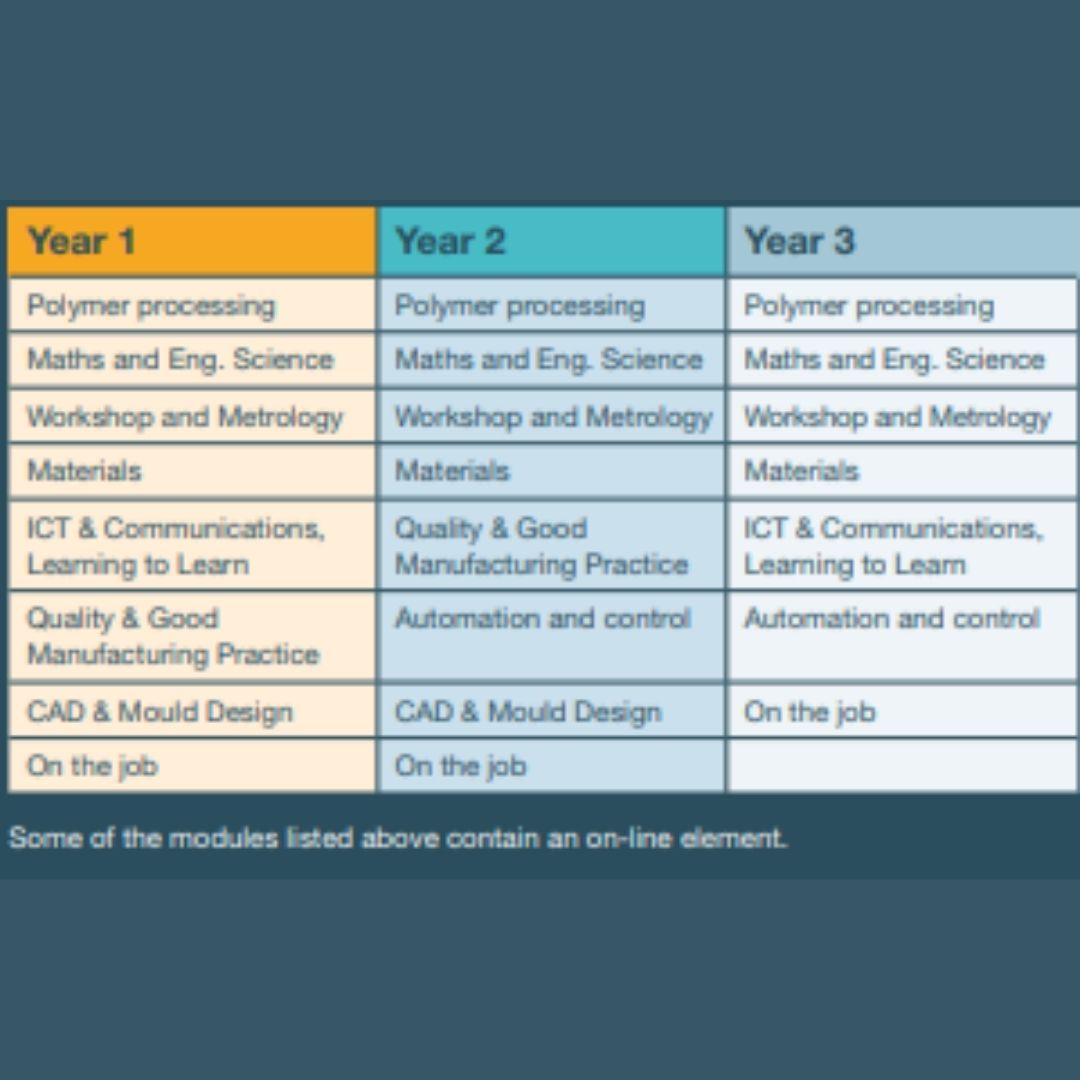
The training is run by the following institutions:
- TUS Tech Univ Shannon (AIT) Athlone Inst of Technology
- SETU SLigo campus (IT Sligo) Inst of technology Sligo
An enquiry or application for the Polymer Processing Technology Apprenticeship can be made on the Polymer Technology Apprenticeship website.
Skills & Qualities
An interest in working and learning in the MedTech, plastics and engineering sectors.
Competencies
- Communications
- Customer service
- Adaptability
- Ability to work in a team
- Ability to work independently and efficiently
- Demonstrate initiative in day-to-day work
- Ability to Problem solve using appropriate tools
- Diagnose processing problems and propose solutions
- Planning
- Information gathering
- Follow Quality procedures/requirements coherently
- Report writing
- Data recording
- Business awareness relating to production costs
- Waste awareness
- Overall equipment efficiencies
- Understand business priorities
- Achieve tasks/objectives as directed by Management
Work Activities
The main skills in this role are:
- Plastics processing
- Moulding characteristics
- Engineering principles
- Reading of engineering drawings
- Thorough understanding of polymer materials and processing.
Polymer processing activities include:
- Injection moulding, blow moulding and extrusion.
- Polymer processing equipment includes materials handling equipment, injection moulding, blow moulding, extrusion equipment, tooling, robotics, metrology equipment, printing, post processing/packaging automation, clean room equipment, 3D printing/additive manufacturing and labelling equipment.
Working with Plastics processing equipment including various systems:
- Electrical, electro-mechanical, electro-pneumatic, electronic, temperature and pressure control systems, hydraulic, and microprocessor based systems.
In order to function effectively and efficiently, the polymer processing technician must have a broad base of technical knowledge and analytical skills to cover material science, polymer processing and statistical processing control.
Also important is the ability to read technical drawings and machine data and the understand the proper use of test instruments.
Career Progression
The Irish polymer industry is well established and offers a broad range of career opportunities.
- Polymer Sector
- Medical Devices Sector
- Engineering Sector
- Packaging sector
- Contracted Moulders
- Domestic Appliances
Note: People in employment have a number of options for both Educational and Career Progression. It might also be possible to gain promotion within your existing company. By using your existing qualifications and your experience you might to able to secure an alternative position in a more senior role in another company. It may also be possible to set up your own company based again on your existing qualifications and experience.
On successful completion of this programme, apprentices can progress onto Level 7 Polymer/Mechanical/Quality degree programmes. (Leading to occupations such as Polymer/Mechanical/Process/Project/Validation/QA Engineers). Diagram - TUS BSc in Polymer Processing Technology (Apprenticeship) - ATU Sligo BEng (Hons) in Polymer Processing Engineering Part Time - TUS MSc in Advanced Polymer Materials Part Time - TUS / ATU Sligo PHD.
Whatever route you decide to take remember education is a lifelong pursuit and you can always continue to up skill and/or retrain, whatever your age. Links to some enterprise supports can be found below.
Enterprise and Self-Employment Support:
On completion of anapprenticeship if you feel you have the appropriate knowledge, skills and experience you may decide to set up your own business. The links below might be useful to support you:
- Local Enterprise Offices, For profit Local enterprise support
- Local Area partnerships For profit enterprise support
- Social entrepreneurs: Not-for-profit enterprise support
- Franchising: Developing your business under an established franchise
Getting this Apprenticeship
To become an apprentice in Ireland you must be hired by an employer. Apprenticeship employers are formally approved by SOLAS in advance of employing apprentices. Apprentices get a formal contract of employment as part of their apprenticeship.
To find an apprenticeship, you can search apprenticeship vacancies and a list of currently approved apprentice employers on the Apprenticeship Jobs & Employers Portal. You can search for vacancies by location, and employers in each apprenticeship.
Use this link to explore a list of Approved Employers by Region and by Apprenticeship type.
This apprenticeship is managed by Plastics Ireland. If you are interested in a Polymer Processing Technology Apprenticeship you should make contact with Plastics Ireland via the contact details in the ‘Find Out More Section’ below.
Full eligibility criteria for this apprenticeship are available in the Polymer Processing Technology Apprenticeship brochure. - click here.
Further information is also available from the industry lead for this apprenticeship:
Polymer Technology Ireland
IBEC
84-86 Lower Baggot Street
Dublin 2
Tel: + 353 (0)1 605 1727/ 087 715 7967
Email: [email protected]
Web: polymertechnologyapprenticeships.ie
An enquiry or application for the Polymer Processing Technology Apprenticeship can be made on the Polymer Technology Apprenticeship website.
Finding an Employer
Finding an employer or registering your interest with an official Coordinating Provider is one of the first things you need to do to start an apprenticeship.
To find an apprenticeship and secure an apprenticeship work contract you can search apprenticeship vacancies on the Apprenticeship Jobs Portal . You can search for vacancies by location and by apprenticeship type.
Your local Education and Training Board may also hold details of employers seeking to employ an apprentice.
You should also directly connect with local employers who might be interested in taking on an apprentice. It is a great idea to get a part time job with a local employer who might be more inclined to take you on as an apprentice following a successful work experience placement or a part time job contract.
Organisations supporting this apprenticeship
Where we know of supporting organisations we list these below:
Online Job Sites
Here are some direct links to employment websites that frequently list apprenticeship vacancies.
Note: These websites may include vacancies that are not QQI accredited Apprenticeships.






Pay & Fees
Company pays apprentice’s salary for both on and off the job phases. Salary set by individual company. Tiered remuneration recommended for 3 year programme. Government pays for college training. Annual apprentice registration fee of €1,500 will apply.