

In Summary
This is a two-year Level 6 apprenticeship for the ICT Sector.
Upon successful completion, you will be awarded an NFQ Level 6 Advanced Certificate in Computer Programming.
An ICT associate professional software developer builds and tests high-quality code across front end, logic, and database layers.
Developers typically work as part of a larger team, in which they have responsibility for some of the straightforward elements of the overall project. While the customer requirements will be typically defined and agreed by more experienced or specialist members of the team, such as a business analyst or technical architect, the developer will be able to interpret design documentation and specifications. Examples of work include information databases, programs that control robotic systems, and cloud and mobile applications.
Fit_Explainer_Tech_Captions from Fast Track into IT on Vimeo.
Programme Structure:
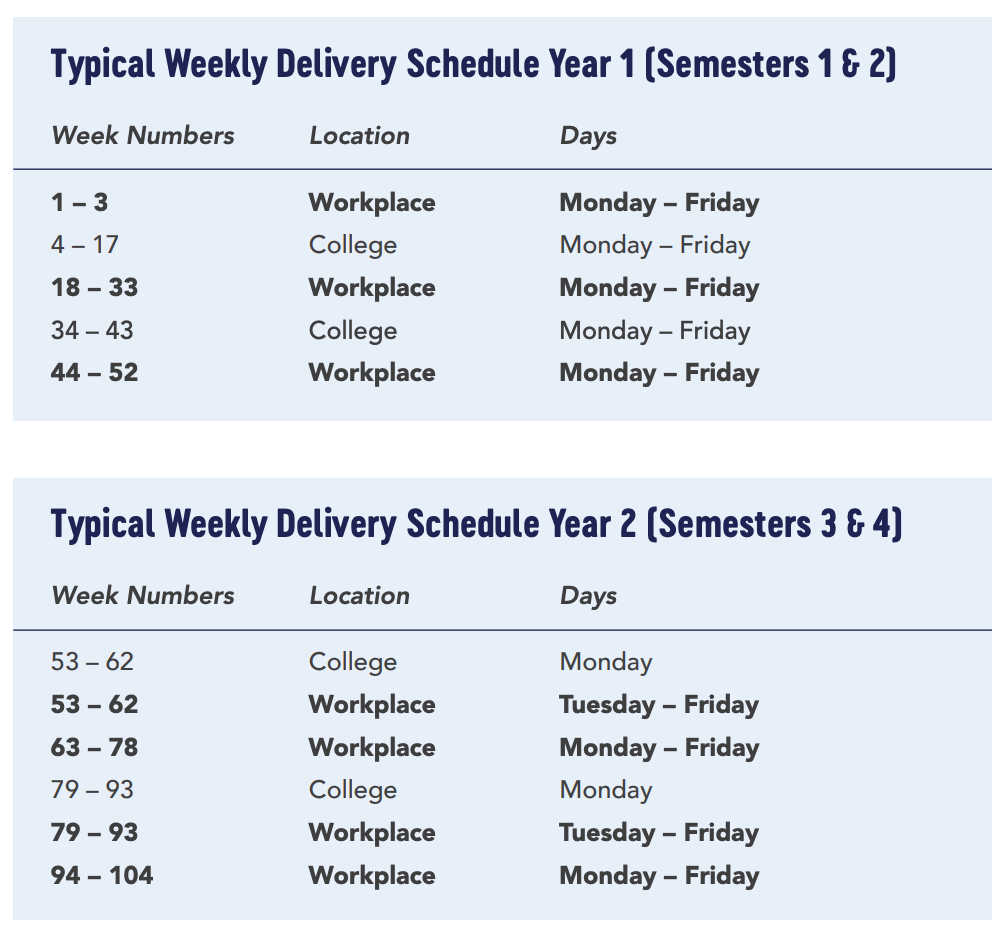
Months 1–6: Full-time off-the-job training
Months 7–18: 3 days of work and 2 days off-the-job training per week
Months 19–24: 4 days of work and 1 day off-the-job training per week
How to Apply:
You can apply for the Tech Apprenticeships at any time. Once recruitment opens for your chosen programme, you will be invited to attend an information and aptitude session.
To apply for an ICT Associate Apprenticeship, please click here .

Read Alina's Apprenticeship Success Story Here!
View Occupation Profile from Apprenticeship.ie
To view full details of this occupation, view information from our Careers database for the following occupation: Software Development Associate
Entry Requirements
Before applying for this apprenticeship, please check that you meet all entry requirements outlined below:
Minimum candidate entry requirements
A successful candidate:
Must be 18 years or older.
Will be required to complete an initial aptitude test.
Must have achieved a passing grade (or O6/H7) in 5 or more subjects, including Mathematics and English (both at Ordinary Level or above), in the Irish Leaving Certificate.
Must be eligible to participate in Further Education and Training programmes.
Must be entitled to study and work in Ireland.
Recognition of Prior Learning (RPL)
The Recognition of Prior Learning process may be used to assess equivalency for candidates who do not hold a suitable Leaving Certificate qualification.
Candidates who do not hold a suitable Leaving Certificate qualification may be assessed through the Recognition of Prior Learning (RPL) process to determine if they meet the entry requirements.
Additionally, those who have completed a FIT-recognised Pre-Tech Apprenticeship programme can submit supporting evidence, along with their Junior Certificate transcript, as part of this assessment.
View more details on eligibility criteria at fit.ie
Key candidate skills and attributes
A successful candidate must:
Be numerate and literate.
Have good learning skills.
Be interested in technology and customer service.
Have the ability to absorb product knowledge.
Be motivated and analytical.
Possess good communication skills, a pleasant personality, and be determined to succeed.
Have excellent interpersonal skills.
Be able to work as a team member.
Be adaptable and flexible.
Training
It is important to understand the level of commitment required for the ICT Software Developer Apprenticeship before applying for this programme.
The ICT Associate Professional programme follows a “learning by doing” approach to ICT skills development, which is endorsed by both industry and government.
This is a two-year programme designed for capable and motivated tech enthusiasts. Successful candidates will be awarded an NFQ Level 6 Advanced Certificate in Computer Programming.
The table below outlines the typical schedule of on-the-job (workplace) and off-the-job (college-based) training for this two-year, full-time apprenticeship programme. Full-day attendance is mandatory for all scheduled training sessions, whether they take place in the workplace or at college.
The college-based training component is primarily delivered in person. Apprentices are informed of the specific training arrangements once they are preparing to begin employment with their apprenticeship sponsor. In most cases, this training is conducted at an Education and Training Board (ETB) facility, located throughout the Republic of Ireland. These facilities are equipped to provide a high-quality learning experience.
Where possible, FIT aims to match the location of college-based training with the geographic area of the employer’s operations. However, this may not always be feasible, and apprentices must be prepared to travel to attend training at designated locations when required.
In certain intakes, and subject to accreditor approval, some college-based training may be delivered through a blended learning model. In these cases, apprentices may complete part of their training remotely—either from home or their workplace—via a virtual classroom. However, some in-person attendance will be necessary.
What will I study?
The Software Development Associate Apprenticeship programme is delivered across four semesters. The titles of these semesters correspond with specific milestones necessary for meaningful apprentice progress.
• Semester 1: Laying the Foundation.
• Semester 2: Introducing the Workplace.
• Semester 3: Consolidation.
• Semester 4: Preparation for Autonomy
Modules
- Software Development and Design Fundamentals
- Customer Support Provision for the ICT Professional
- Web Development
- Software Development
- Data & Cybersecurity
- Install, Configure, and Upgrade ICT software
- Object Oriented Programming
- Programme Management and Agile Systems of Work
- Event-Driven Programming
- Quality Assurance and Software Testing
- Systems Development
- Introduction to Cloud Development Practice
- Applied Learning in the Workplace
By the end of your training, you will be able to:
- Write professional quality code with sound syntax in at least one language.
- Develop effective user interfaces.
- Test code and analyse results to correct errors found using either V-model manual testing and/or using unit testing.
- Apply structured techniques to problem solving, debug code and understand the structure of programmes in order to identify and resolve issues.
- Operate at all stages of the software development lifecycle, with increasing breadth and depth over time with initial focus on build and test.
- Create functional data models and software designs.
Click here to view the Software Development Associate Apprenticeship programme syllabus .
To apply for apprenticeships please click here .
To view the scheduled programmes and locations click here .
The training is provided by the following institutions:
(Please check with your local ETB as this list may change.)
- Mayo Sligo Leitrim ETB
- Limerick and Clare ETB
- Donegal ETB
- Dublin & Dun Laoghaire ETB
- Galway & Roscommon ETB
- Waterford & Wexford ETB
- Louth & Meath ETB
- Cavan & Monaghan ETB
- Laois & Offaly ETB
- Tipperary ETB
- Longford & Westmeath ETB
- City of Dublin ETB
- Kildare & Wicklow ETB
- Kilkenny & Carlow ETB
- Kerry ETB
- Cork College of FET (Cetb)
- Kerry College
Skills & Qualities
Key candidate skills and attributes
A successful candidate must:
• Be numerate and literate.
• Have good learning skills.
• Be interested in technology and customer service.
• Have the ability to absorb product knowledge.
• Be motivated and analytical.
• Possess good communication skills, a pleasant personality, and be determined to succeed.
• Have excellent interpersonal skills.
• Be able to work as a team member.
• Be adaptable and flexible
On successful completion of this apprenticeship, the Software Development Associate will be able to:
Knowledge
- Understand and operate at all stages of the software development lifecycle
- Understand the similarities and differences (taking into account positives and negatives of both approaches) between agile and waterfall software development methodologies
- Understand how teams work effectively to produce software and contributes appropriately
- Understand and apply software design approaches and patterns and can interpret and implement a given design, compliant with security and maintainability requirements
- Understand and respond to the business environment and business issues related to software development
- Understand and operate effectively in their own businesses, their customers and the industry’s environments
- Understand and apply the maths required to be a software developer (e.g. algorithms, logic and data structures)
Skills
- Write good quality code (logic) with sound syntax in at least one language.
- Develop effective user interfaces.
- Effectively link code to the database/data sets.
- Test code and analyse results to correct errors found using either V-model manual testing and/or using unit testing.
- Apply structured techniques to problem solving, can debug code and can understand the structure of programmes in order to identify and resolve issues.
- Create functional data models and software designs to effectively communicate understanding of the program, following best practices and standards.
- Understand and create basic analysis artefacts, such as user cases and/or user stories.
- Utilise skills to build, manage and deploy code into enterprise environments.
- Operate at all stages of the software development lifecycle, with increasing breadth and depth over time with initial focus on build and test.
- Apply good practice approaches according to the relevant paradigm (for example object oriented, event driven or procedural).
- Interpret and follow:
- software designs and functional/technical specifications
- company defined ‘coding standards’ or industry good practice for coding
- testing frameworks and methodologies
- company, team or client approaches to continuous integration, version and source control
Work Activities
The FIT ICT Associate Professional programme offers technical education and training grounded in practical experience, ensuring that participants are ready for work on completion. The FIT ICT Associate Professional Programme will:
- Develop in-demand tech skills.
- Provide hands-on learning to attain the skills demanded by industry.
- Provide an opportunity to earn and learn.
- Award a national qualification over a two-year period.
- Equip participants with the knowledge and capabilities to progress in ICT careers.
- Lead to internationally recognised qualifications.
- Provide the opportunity to apply theoretical education and training in a real work setting helping to build confidence in your abilities and gain independence.
A FIT ICT Associate Professional spends a significant portion of their time training within a company, where they gain practical experience using modern technology and equipment while actively participating in real-world work processes. This hands-on approach helps them effectively develop the skills required in today’s workplace.
On successful completion of this apprenticeship, the ICT Associate Professional Software Developer will be able to:
- Perform systems analysis and design investigations using recognised methodologies.
- Understand how object-oriented programming concepts are used in programming and systems development.
- Design, create, implement, and test programming solutions.
- Use event-driven programming concepts in programming and systems development.
- Use procedural programming concepts in programming and systems development.
- Implement the principles of software application testing.
- Develop skills to test, implement, and evaluate software applications prior to commercial deployment regardless of the programming language being used.
- Use the principles of project management to set up new projects.
- Mitigate for risks and develop skills in using management tools to monitor and review projects.
- Understand the importance of effective communication, such as written, verbal, and non-verbal, in a business environment.
- Understand why effective communication is critical for businesses by using different types of communication methods suitable for specific purposes.
- Understand the systems development life cycle.
- Identify the various stakeholder perspectives to ensure that the solution meets requirements and that the broader implications are considered.
- Develop practical skills in the use of the various tools and techniques associated with different methodologies for systems development.
- Use different methods and resources available to help plan for personal and professional development.
- Learn how to identify factors that may affect targets or goals, prioritise actions, and utilise feedback from others to aid their development and career progression.
- Develop a plan which can either be used during a course of study or as a tool for future and current career paths.
View Occupational Profile from Apprenticeship.ie for a more details on knowledge, skills, and competencies.
Career Progression
Most ICT Associate Professional Software Developers will work in ICT sector industries involved in researching, developing, designing, selling, installing, and maintaining software products and services. However, many will also find roles in other sectors that use, develop, and apply software solutions to support their operations.
Upon successful completion of the programme and achievement of the FIT ICT Associate Professional (ICTAP) Award, candidates are expected to progress into full-time roles with their sponsoring company.
The ICTAP programme is currently being offered in Dublin, Cork, Galway, Athlone, and Monaghan, with FIT actively partnering with employers in these regions to support programme delivery.
With experience, graduates may advance to senior developer roles with responsibilities in project management, planning, and research, or transition into related areas such as systems design, IT architecture, or business systems analysis.
To find out more: e-mail [email protected] or by phone on 01 8825570.
Software products, applications, and services are widely used across nearly all sectors of the modern economy. While most ICT Associate Professional Software Developers will work within the ICT sector—developing, designing, selling, installing, and maintaining software—a significant number will also work in other industries that rely on software solutions to support their operations.
Graduates of the apprenticeship programme are eligible to apply for entry into any Bachelor of Science in Computing programme. Based on their application and prior learning, they may also be considered for advanced entry.
FIT currently has an agreement with Technological University Dublin that allows apprenticeship graduates to enter directly into Year 2 of the BSc in Computing. In addition, FIT is in advanced discussions with Griffith College to establish a Level 8 Software Development Apprenticeship programme. This would enable seamless progression from the Level 6 award to a Level 8 qualification.
FIT collaborates with Atlantic Technological University (ATU) Sligo to create a clear progression route for apprentices completing FIT’s Level 6 ICT Apprenticeships (in Software Development and Network Engineering). ATU Sligo is developing a specific Level 8 Honours Degree in Computer Science aimed at becoming a direct progression pathway for these apprentices.
ATU Sligo's structure supports advanced entry into Year 2, 3, or even Year 4 of the Level 8 programme for learners holding a cognate QQI/FET Level 6 Major award—with the possibility to reduce the total years of study required.
Graduates of the Software Development Apprenticeship Programme at FIT will also have the opportunity to progress onto a BSc (Honours) top-up degree in Computing and IT Practice at the Open University in Ireland.
FIT is working towards creating links with providers of further and higher education to facilitate entry/advanced entry to additional programmes.
These include:
- TU Dublin (TU)
- National College of Ireland (NCI)
- Dublin City University (DCU)
- Griffith College
- CCT College Dublin (CCT)
Other pathway options include Springboard and conversion courses or post graduate pathways.
Getting this Apprenticeship
To become an apprentice in Ireland you must be hired by an employer.
Apprenticeship employers are formally approved by SOLAS in advance of employing apprentices.
Apprentices get a formal contract of employment as part of their apprenticeship.
To find an apprenticeship, you can search apprenticeship vacancies and a list of currently approved apprentice employers on the Apprenticeship Jobs & Employers Portal . You can search for vacancies by location and employer in each apprenticeship.
Search a list of Approved Employers by Region and by Apprenticeship type here .
You can apply to link up with over 250 participating employers across Fastrack into IT apprenticeship programmes including:
Your Local ETB Education and Training Board may also hold details of employers seeking to employ an apprentice.
Fastrack into Information Technology (FIT) . If you are interested in a network engineer associate apprenticeship you should make contact with FIT via the contact details in the ‘Find Out More Section’ below.
Full eligibility criteria for this apprenticeship are available in the Software Development Associate Apprenticeship brochure .
Further information is also available from the co-ordinating provider for this apprenticeship:
Fastrack into Information Technology
7A Bellevue Industrial Estate
Glasnevin
Dublin 11
Tel: + 353 (0)1 882 5570
Email: [email protected]
Web: www.fit.ie
Or apply online on the FIT (Fast-track to Information Technology) website .
Finding an Employer
Finding an employer or registering your interest with an official Coordinating Provider is one of the first things you need to do to start an apprenticeship.
To find an apprenticeship and secure an apprenticeship work contract you can search apprenticeship vacancies on the Apprenticeship Jobs Portal . You can search for vacancies by location and by apprenticeship type.
Your local Education and Training Board may also hold details of employers seeking to employ an apprentice.
You should also directly connect with local employers who might be interested in taking on an apprentice. It is a great idea to get a part time job with a local employer who might be more inclined to take you on as an apprentice following a successful work experience placement or a part time job contract.
Further information about this apprenticeship may be available from the following organisations on this website:
Organisations supporting this apprenticeship
Where we know of supporting organisations we list these below:
Online Job Sites
Here are some direct links to employment websites that frequently list apprenticeship vacancies.
Note: These websites may include vacancies that are not QQI accredited Apprenticeships.





Pay & Fees
As an apprentice, you earn while you learn. The employer pays you a salary while you are being trained on-the-job and off-the-job. The rate of pay is agreed between you and your employer.
As a software developer associate you will earn approximately €260 per week in year 1 and €340 per week in year 2 of the apprenticeship.
Software Developer Associate
| Year 1 | €260 * |
| Year 2 | €340 * |
| * Rates are approximate |
Apprentices are not required to pay a student contribution for this apprenticeship.