Subject Choice at Senior Cycle
How to Choose Leaving Cert Subjects
Remember the 3 questions
1.What subjects do you enjoy?
Research the subjects carefully to understand what they involve. Use the links below. There is often quite a difference in their content and level from JC
2. What subjects do you need?
You need both points and certain subjects to matriculate for CAO (points based) courses. Use https://careersportal.ie/courses/simple_search.php to filter the ‘Entry Requirements’ on the left-hand side of the page (for example – Lanaguages, Higher Maths, Science)
3. What subjects can you get points in?
What subjects would suit your attitude to learning, your aptitude for learning and your style of learning? Are you willing and able to work hard for content-based subjects?
- Do you have strong abstract reasoning for Science? Test your Abstract reasoning
- Do you have strong spatial reasoning for DCG? Test your Spatial reasoning
- Is your learning style suited to projects? Would you be suited to the project-work in LCVP Link Modules ?
- What grades did you get in the Junior Cert that might support your Subject Choice e.g. if you are thinking about Chemistry, what did you get in JC Science?
- Subject grade Explorer What subjects got what grades last year in the Leaving certificate?Compare different subjects for grades e.g. Gaelige to English for H1 to H3? Music to Geography for H1 to H3?
This test is a non-verbal, non-numerical measure of reasoning power. It tests the ability to see relationships among objects, patterns, diagrams or designs. This skill is useful in careers requiring the person to see relationships between objects in terms of their size, shape, position and quantity.
- Maths, Computers, Animation
- Design, Architecture, Mechanic
- Art, Construction, Photography
- Carpentry, Conservation, Law
- Forensic Scientist, Laboratory Technician
Applied Maths, Art, DCG, Construction Studies, Chemistry
This test measures the ability to visualise, to think in three dimensions or to picture mentally the size, shape and position of objects when shown only a two dimensional picture or pattern. This skill is vital in order to understand technical drawings.
- Architects, Fashion Design
- Architectural Technicians, Interior Design
- Engineers, Industrial Design
- Creative Artists Stage / Set Designers
- Photographers, Town Planner
- Hairdressers
- Designers, Jewellery Designers
- Surveyors, Technical Illustrator
- Animators
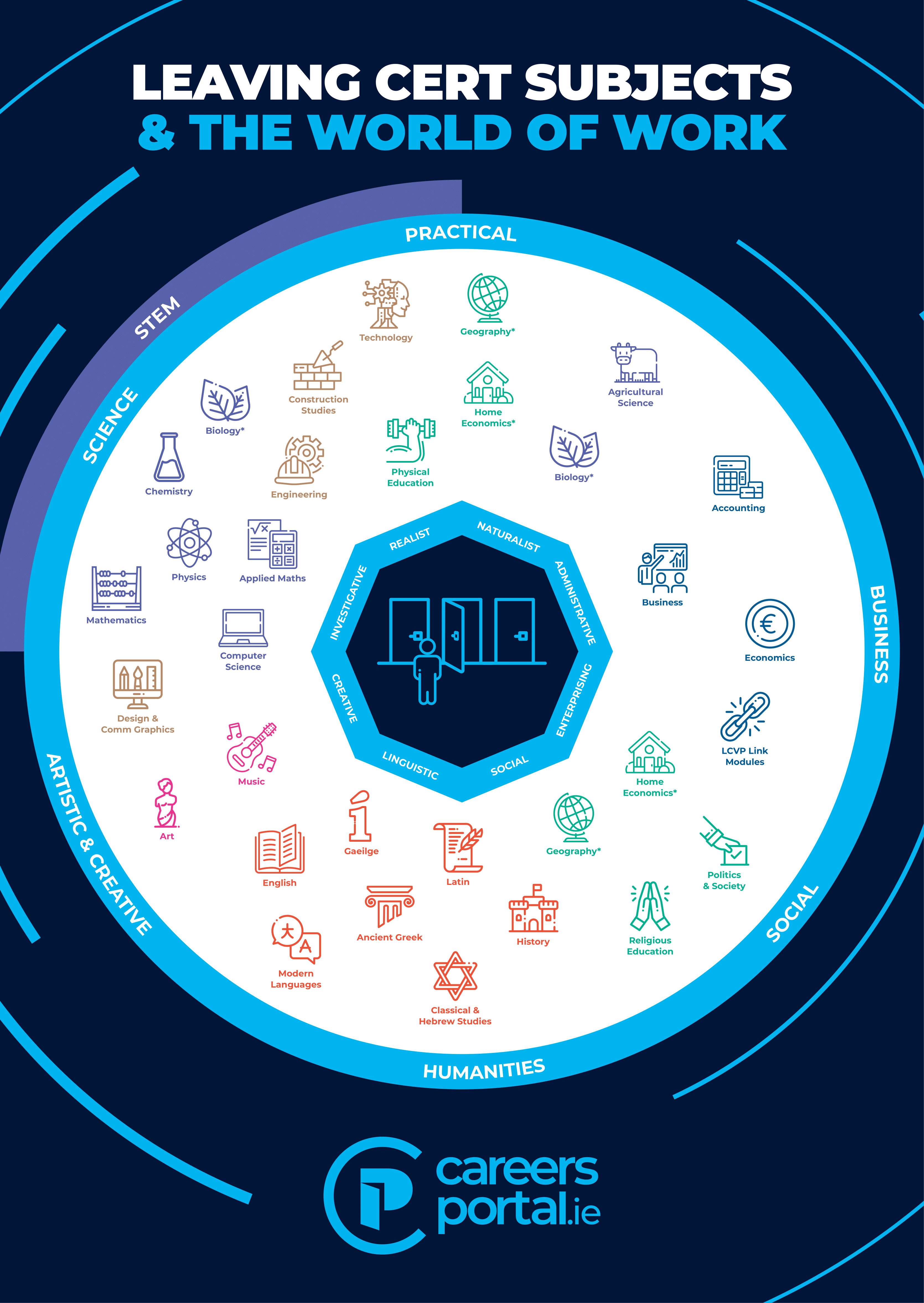
Consider the following subjects: Art, Home Economics, Construction, Geography, DCG
| Content-Based Subjects | Understanding Subjects | Skill/ Practical Based Subject |
|
Geography History Biology Home Economics Art* AgriculturalScience Business Studies Physical Education |
Physics Home Economics *Chemistry Applied Maths Economics Accounting* |
French Spanish Music Art Physical Education DCG Accounting Construction Studies Engineering LCVP |
- This is a practical subject/programme that suits practical students.
- It is a real preparation for the world of work.
- The bulk of marks go for the portfolio which is done over the 2-years
- Links with other option subjects which can enhance performance in those subjects.
- Promotes skills and qualities of self-reliance, innovation and enterprise
Skills learned through LCVP such as planning, researching, writing reports and making presentations are keys to your success at third level. The LCVP may be counted as one of the six subjects when calculating points.
LCVP students also take three Link Modules on Enterprise Education, Preparation for Work and Work Experience.
The LCVP combines the academic strengths of the Leaving Certificate (established) with a dynamic focus on self–directed learning, innovation and enterprise. During this two year programme students complete a portfolio of work that accounts for 60% of their overall grade. The terminal exam, which takes place in May of the 6th year, accounts for the remaining 40%. Participants in the programme are encouraged to develop skills and competencies fundamental to both academic and vocational success.
Distinction, merit and pass grades are awarded to successful candidates. CAO points are awarded for these grades (Distinction 66 points, Merit 46 points and Pass 28 points). The points awarded for LCVP can count as one of the six subjects that qualify for CAO points.
** LCVP: if you wish to sit this subject, you need to have one of the subject combinations below
| Vocational Subject Groupings (VSGs) 2017/2018 |
| Specialist Groupings |
| 1 Construction Studies; Engineering; Design and Communication Graphics; Technology – Any Two 2 Physics and Construction Studies or Engineering or Technology or Design & Communication Graphics 3 Agricultural Science and Construction Studies or Engineering or Technology or Design & Communication Graphics 4 Agricultural Science and Chemistry or Physics or Physics/Chemistry 5 Home Economics; Agricultural Science; Biology – Any Two 6 Home Economics and Art – Design Option or Craft Option 7 Accounting; Business; Economics – Any two 8 Physics and Chemistry 9 Biology and Chemistry or Physics or Physics/Chemistry10 Biology and Agricultural Science11 Art – Design Option or Craft Option and Design & Communication Graphics |
| Services Groupings |
| 12 Engineering or Technology or Construction Studies or Design & Communication Graphics and Accounting or Business orEconomics 13 Home Economics and Accounting or Business or Economics 14 Agricultural Science and Accounting or Business or Economics 15 Art Design or Craftwork Option and Accounting or Business or Economics 16 Music and Accounting or Business or Economics |
Leaving Cert Subject Choice 2021
Subject choice decision time – what subject might best suit you?
.jpg "Leaving Cert Subject Choice 2020")
Implication of Subject Choice and College Courses:
|
Matriculation requirements To be allowed into a college for any course offered at that college, you first meet the college entry requirements – each college has their own rules, so you must research them individually. For example, particular subjects required, grades, the number of points required etc.From 2017 onwards, all Level 8 college courses require students to achieve two H5 grades and four O6/H7 grades in the Leaving Cert. Trinity College Dublin requires students to achieve three H5s and three O6/H7 grades. Subject Requirement Many college courses require that you have achieved a specific grade or above, in a particular subject to Leaving Cert level, to be eligible for entry. It is important to be aware of this when choosing Senior Cycle subjects. |
Languages
It is widely believed that if a student does not study a language for the Leaving Cert they will not be able to attend third level – this is not entirely the case, but having a language in the Leaving Cert can greatly impact choices. Some schools allow students not to take a language for Leaving Cert – the decision to drop a language should not be taken lightly.
Impact of Dropping a Language
Some third level colleges do not require entrants to have a European language in order to meet the matriculation, or minimum entry requirement.
- At Trinity College Dublin, students are required to pass English and another language, and Maths or Latin.
- The matriculation requirements for DCU are Maths and English or Irish.
- UL – The University of Limerick requires students to have English, Maths and Irish or another language.
So, a student who does not take a foreign language at Leaving Cert will typically meet the entry requirements for these universities, as long as they take Irish, or have an Irish exemption.
The colleges of the National University of Ireland (NUI) have traditionally required a pass in a third language for entry to many courses in the NUI colleges at Maynooth, UCD Dublin, NUIG Galway and UCC Cork, and to a range of associated constituent colleges, all of which are listed on the NUI website.
More recently, NUI colleges dropped their third language requirement for Engineering and Science programmes. UCD also dropped the third language requirement for a number of other courses including Agricultural and Law.
Nursing at NUI colleges never required a third language.
The Institutes of Technology generally expect students to have O6/H7 in English and Maths – not choosing a language should have no impact on a candidate’s ability to get place in one of their programmes.
PLC colleges do not require students to have taken a language.
A modern European language will also be required for application to cadetships in the Defence Forces.
So, while not choosing a language will not affect entry to the majority of third level institutions, it will restrict choice to some extent.
Science Subjects:
Holding on to one Science subject for Senior Cycle (Biology, Physics, Chemistry, Physics & Chemistry, Agricultural Science) keeps several college options open including all Healthcare courses, most Science courses, Sports & Physical Education and Engineering courses.
Exemption from Irish
A student with an Irish exemption may apply for exemption from the requirement to present Irish as a matriculation subject from the university they will be applying to [Find out more here]. Students can also apply to NUI for an exemption from the requirement to have a third language* [Find out more here ].
Advice: keep as many options as possible open.
The exact requirements for entry to individual college courses are presented each year in the college prospectus and online – use the available Course Finder filters to explore:
Further Research:
CareersPortal has dedicated subject choice pages for all 2nd Level students including detailed information on each subject and expert career advice.
These pages also link to related sections including more Useful Tips and Expert Advice on choosing the right subjects for you, visit the full School section by following this link
Subject Choice Frequently Asked Questions
| SUBJECT CHOICE FAQS |
|---|
|
Frequently Asked Questions 1. HOW MANY SUBJECTS SHOULD I TAKE AND AT WHAT LEVEL? Your school will probably offer you the option of studying seven subjects. Your best six grades, achieved in one sitting of the Leaving Certificate or its equivalent, will be used to calculate your point score for entry purposes to college courses.If you are taking more than one ordinary level paper from the beginning of your two-year Leaving Cert programme, you may want the option of having six higher-level papers for point’s purposes.You can only achieve this by taking an extra subject either inside or outside school. You need to be very careful before considering this option. There is no such thing as an easy higher level paper and every subject requires considerable time commitment and effort on your part. Eight subjects are a major undertaking. If the additional subject is being studied outside school, you should factor in the time travelling to and from such a grind. All this time and effort eats into the time available to you to work on the seven subjects you are studying in school. 2. ARE THERE ANY SUBJECTS I HAVE TO CHOOSE? Unless you are exempt from any subject, students must choose English, Irish and Maths. Other than these subjects, it is important to check any subject requirements there are for your preferred college course.
3. SHOULD STUDENTS TAKE ON EXTRA SUBJECTS OUTSIDE SCHOOL?If there are timetable restrictions that make it impossible for you to take a subject you particularly enjoy, you could consider taking it outside school, provided you factor in an appropriate amount of study time to cover all your other subjects.
4. WHAT HAPPENS IF I DO NOT TAKE HIGHER LEVEL IRISH?Apart from ruling out a number of honours degree programmes which have Irish as a core entry requirement, the main consequence of dropping higher level Irish is that you are precluded from studying to be a primary school teacher in any of the education training colleges in Ireland.
5. WHAT HAPPENS IF I DO NOT TAKE HIGHER LEVEL MATHS?There are many Level 8 degree programmes you can’t take if you don’t get a minimum grade H3 / H4 in maths (i.e. engineering, computer science, science, information and computer technology courses and many degrees that include maths as a core subject).If you are interested in any of these areas, you could start your third level journey with a two-year higher certificate programme, which will require a grade O6/H7 in maths. Provided you secure a minimum of 60 per cent in your various examinations, you can then progress on to ordinary degree level and from there to an honours bachelor’s degree. This process may add one or two extra years to your studies, over and above those who secure a place on an honours bachelor’s degree programme, immediately after the Leaving Cert, but it it still a good option.
6. WHAT HAPPENS IF I DO NOT TAKE A LANGUAGE OTHER THAN IRISH AND ENGLISH?The colleges of the National University of Ireland (NUI) have traditionally required a pass in a third language for entry to many courses in the NUI colleges at Maynooth, Dublin, Galway and Cork, and to a range of associated constituent colleges, all of which are listed on theNUI website . More recently, NUI colleges dropped their third language requirement for engineering and science programmes. UCD also dropped the third language requirement for their agricultural programmes.Nursing at NUI colleges never required a third language. A third language must be included for arts, human sciences, law, social science, commerce, medicine and health sciences and some other degrees.[For full details google NUI Matriculation Regulations] Trinity College Dublin accepts Irish as a second language requirement. UL, DCU and the Institutes of Technology do not require a continental language for entry purposes to most of their courses, apart from those which involve the study of such a language. Students may qualify for an exemption from these requirements if they have a learning difficulty or if they were born outside of the state. The Institutes of Technology generally expect students to have grade O6/H7 in English and Maths – not choosing a language should have no impact on a candidate’s ability to get place in one of their programmes. PLC colleges do not require students to have taken a language. A modern European language will also be required for application to cadetships in the Defence Forces for the army or air corps.So, while not choosing a language will not affect entry to the majority of third level institutions, it will restrict choice to some extent.
7. WHAT IS THE EASIEST SUBJECT IN THE LEAVING CERT AND WHAT’S THE HARDEST? No Leaving Cert subject is easy, but studying something you are really interested in will make it seem easier and, as a result, you will probably get higher marks in it. If you dislike a subject, you will need to work harder to achieve a good grade and your motivation will need to be strong.
8. WHAT COMBINATIONS OF SUBJECTS WORK? You should attempt to select a balanced range of subjects that will leave your further and higher education options open for as long as possible. Most students study Irish (unless exempted), English and Maths. A large majority of students also study a continental language, or for those students coming originally from outside the EU, a native language approved by the State Examination Commission (SEC).In selecting your remaining three subjects, you should consider what third level courses you might be interested in when you leave school. If you have specific courses in mind, check that your subject choices and levels match the entry requirements for these courses.[Tip: Go to CAO CourseFinder, select (click) the CAO course that interests you, and follow the information links to Qualifax or the College Website to find the specific entry requirements.]You may also want to check what courses you may be excluded from if you take or don’t take a particular leaving cert subject. You can find this information by looking at the ‘Third Level Entry Requirements’ section for each of the subjects listed in the Leaving Cert Subjects area on this page.Unless you have a specific career or course interest that is guiding your remaining subject choices, the advice is to spread your final three choices across the entire spectrum of business, scientific, humanities and practical subjects.You should also be mindful of the results of previous examinations, parent-teacher meetings, aptitude results (se when making these choices.
9. IF I DON’T KNOW WHAT I WANT TO SUDY AT THIRD LEVEL YET, WHAT SUBJECTS SHOULD I CHOOSE? It is advisable to take a good mixture of subjects, a language and a science subject are important. Choose what you enjoy and what you are good at. Reviewing previous aptitude and interest profiler results will help you in determining the career path that might suit you. |