
Work Environment
This occupation is typically found in the following Career Sector(s):
Videos on the Web
- Forestry Machine Operator - from: Youtube Search
Most commonly reported Work Activities
- Performing for or Working Directly with the Public Performing for people or dealing directly with the public. This includes serving customers in restaurants and stores, and receiving clients or guests.
- Performing General Physical Activities Performing physical activities that require considerable use of your arms and legs and moving your whole body, such as climbing, lifting, balancing, walking, stooping, and handling of materials.
- Communicating with Persons Outside Organisation Communicating with people outside the organisation, representing the organisation to customers, the public, government, and other external sources. This information can be exchanged in person, in writing, or by telephone or e-mail.
- Organising, Planning, and Prioritising Work Developing specific goals and plans to prioritise, organise, and accomplish your work.
- Making Decisions and Solving Problems Analysing information and evaluating results to choose the best solution and solve problems.
- Communicating with Supervisors, Peers, or Subordinates Providing information to supervisors, co-workers, and subordinates by telephone, in written form, e-mail, or in person.
- Operating Vehicles, Mechanised Devices, or Equipment Running, maneuvering, navigating, or driving vehicles or mechanised equipment, such as forklifts, passenger vehicles, aircraft, or water craft.
- Identifying Objects, Actions, and Events Identifying information by categorising, estimating, recognising differences or similarities, and detecting changes in circumstances or events.
- Resolving Conflicts and Negotiating with Others Handling complaints, settling disputes, and resolving grievances and conflicts, or otherwise negotiating with others.
- Getting Information Observing, receiving, and otherwise obtaining information from all relevant sources.
Working Life
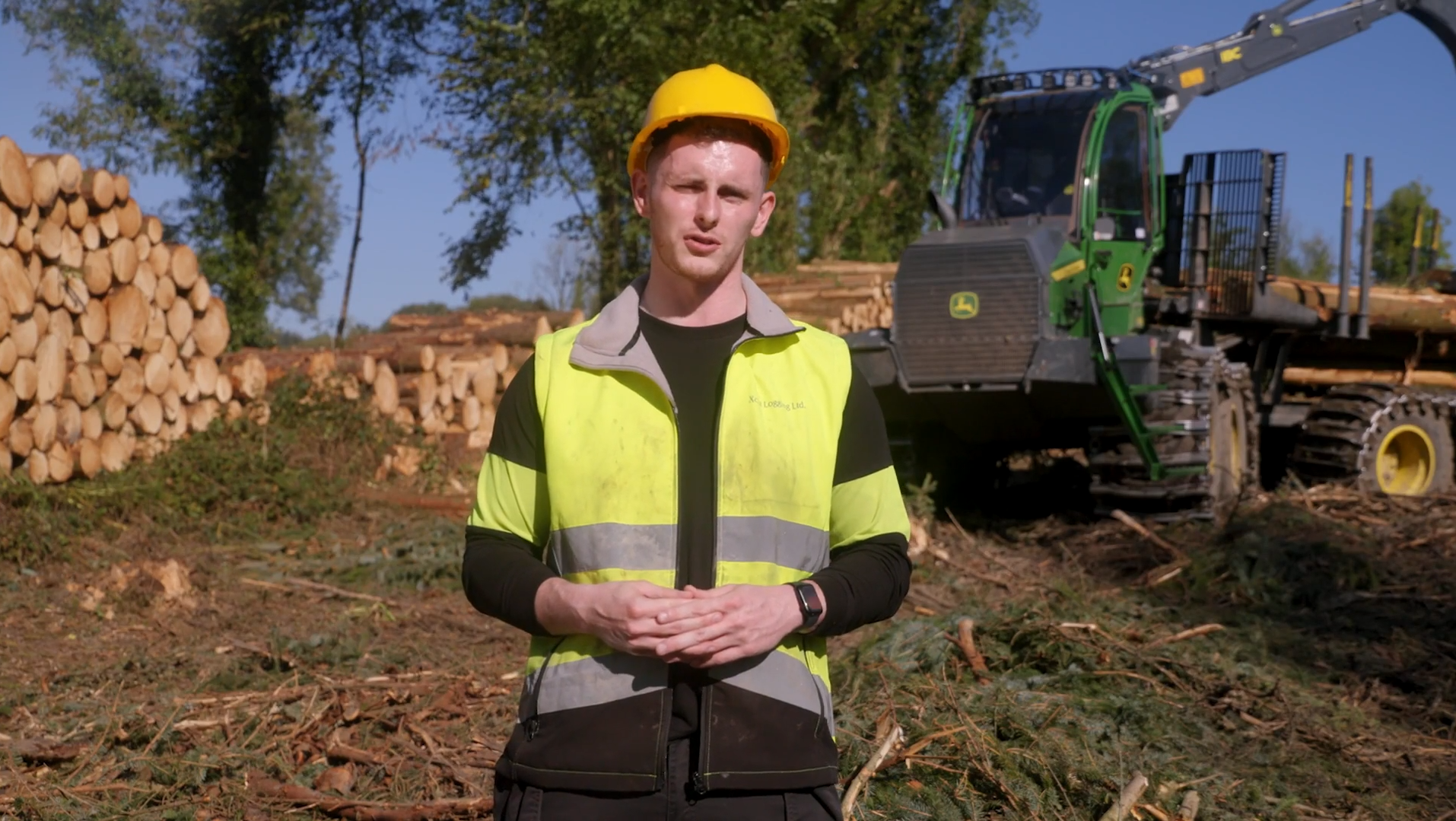
A forestry machine operator is a worker who uses heavy machinery-such as harvesters, forwarders, and loaders-to cut, process, and move trees safely and efficiently in forest operations.
Forest Machine Operators are responsible for:
- Safely operating forestry machinery on uneven and often challenging terrain
- Performing routine machine maintenance and safety checks
- Following environmental and workplace regulations, including health and safety standards
- Working as part of a team to ensure timber is harvested efficiently and sustainably
This is a physically active, hands-on role requiring technical skill, attention to detail, and a strong commitment to workplace safety. Forest Machine Operators play a vital role in sustainable forestry, helping to manage and maintain forests for timber production, conservation, and environmental protection.
Typical employers include Coillte or private contracting firms that work for Coillte and private forest owners.
Most commonly reported Work Tasks
- Check equipment to ensure that it is operating properly.
- Confer with other workers to discuss issues, such as safety, cutting heights, or work needs.
- Gather, package, or deliver forest products to buyers.
- Sow or harvest cover crops, such as alfalfa.
- Spray or inject vegetation with insecticides to kill insects or to protect against disease or with herbicides to reduce competing vegetation.
- Maintain tallies of trees examined and counted during tree marking or measuring efforts.
- Identify diseased or undesirable trees and remove them, using power saws or hand saws.
- Drag cut trees from cutting areas and load trees onto trucks.
- Sort tree seedlings, discarding substandard seedlings, according to standard charts or verbal instructions.
- Operate skidders, bulldosers, or other prime movers to pull a variety of scarification or site preparation equipment over areas to be regenerated.
Qualities - Forestry Machine Operator
- Safety Conscious - follows strict forestry safety rules and emergency procedures.
- Technically Skilled - operates heavy machinery (forwarders & harvesters) and performs routine maintenance.
- Environmentally Aware - works sustainably, protecting soil, water, and biodiversity.
- Detail-Oriented - loads, measures, and stacks timber accurately, minimising waste.
- Physically Fit - able to work outdoors in all weather and challenging terrain.
- Team Player - communicates clearly and coordinates effectively with colleagues.
- Problem Solver - identifies issues, adapts to site conditions, and makes good decisions.
- Reliable & Professional - dependable, with a strong work ethic and commitment to quality.
- Eager to Learn - open to training, new technologies, and continuous skills development.
Interests - Forestry Machine Operator
This occupation is typically suited for people with the following Career Interests:
Naturalist
Not surprisingly, some aspect of the natural sciences will run through the Naturalist's interests - from ecological awareness to nutrition and health. People with an interest in horticulture, land usage and farming (including fish) are Naturalists.
Some Naturalists focus on animals rather than plants, and may enjoy working with, training, caring for, or simply herding them. Other Naturalists will prefer working with the end result of nature's produce - the food produced from plants and animals. Naturalists like solving problems with solutions that show some sensitivity to the environmental impact of what they do. They like to see practical results and prefer action to talking and discussing.
Realist
Realists are usually interested in 'things' - such as buildings, mechanics, equipment, tools, electronics etc. Their primary focus is dealing with these - as in building, fixing, operating or designing them. Involvement in these areas leads to high manual skills, or a fine aptitude for practical design - as found in the various forms of engineering.
Realists like to find practical solutions to problems using tools, technology and skilled work. Realists usually prefer to be active in their work environment, often do most of their work alone, and enjoy taking decisive action with a minimum amount of discussion and paperwork.
Administrative
Administrative people are interested in work that offers security and a sense of being part of a larger process. They may be at their most productive under supervisors who give clear guidelines and while performing routine tasks in a methodical and reliable way.
They tend to enjoy clerical and most forms of office work, where they perform essential administrative duties. They often form the backbone of large and small organisations alike. They may enjoy being in charge of office filing systems, and using computers and other office equipment to keep things running smoothly. They usually like routine work hours and prefer comfortable indoor workplaces.
Entry / Progression - Forestry Machine Operator
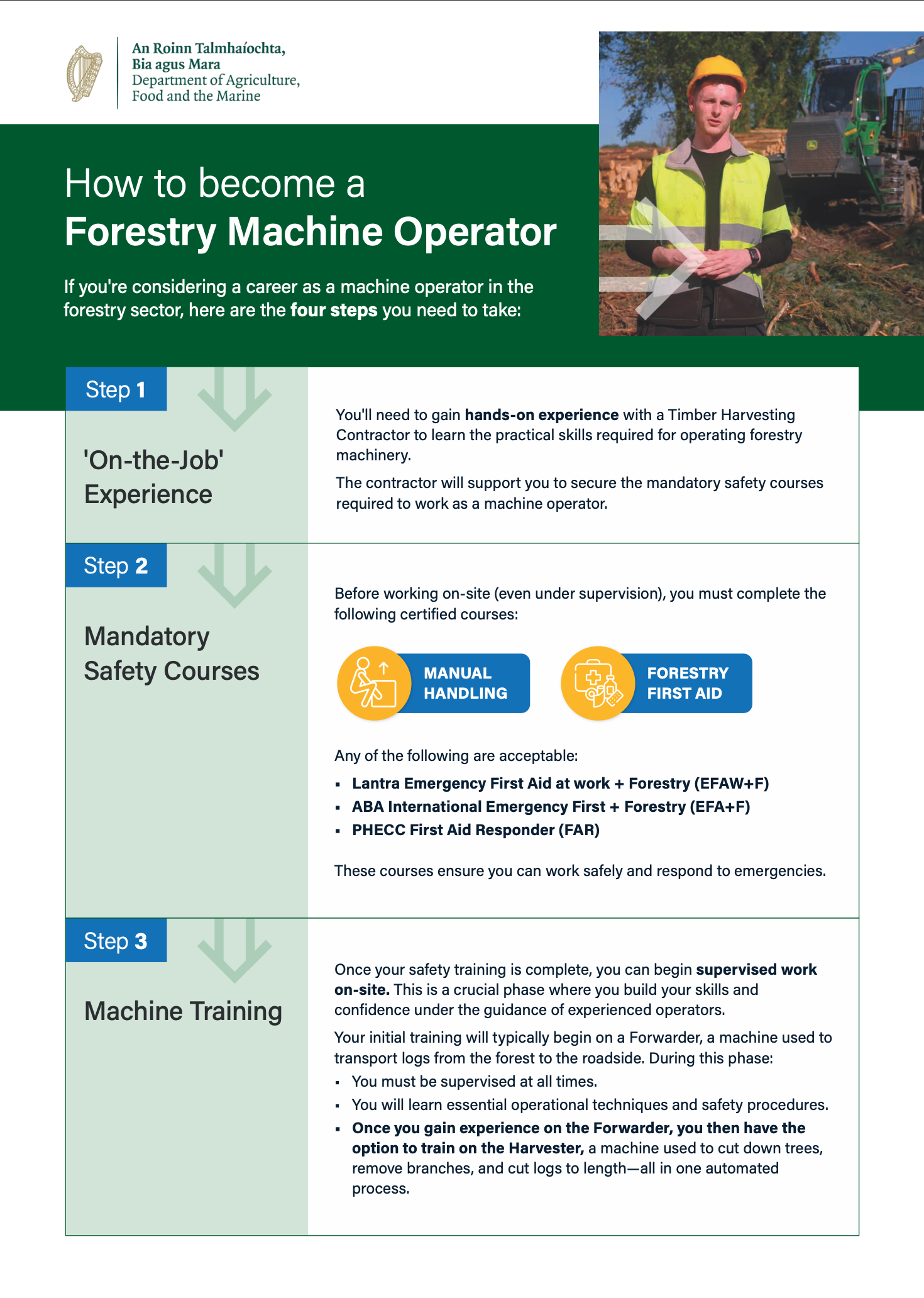
Step 1: On-the-job Experience
■ You'll need to gain hands-on experience with a Timber Harvesting Contractor to learn the practical skills required for operating forestry machinery.
■ The contractor will support you to secure the mandatory safety courses required to work as a machine operator.
Step 2: Mandatory Safety Courses
■ Before working on-site (even under supervision), you must complete the following certified courses:
- Manual Handling - to safely lift, move, and manoeuvre loads.
- Forestry First Aid - many forestry contractors will require you to have a first aid qualification suitable for outdoor and remote work.
Any of the following are acceptable:
- Lantra Emergency First Aid at work + Forestry (EFAW+F)
- ABA International Emergency First + Forestry (EFA+F)
- PHECC First Aid Responder (FAR)
These courses ensure you can work safely and respond to emergencies.
Step 3: Machine Training
Once your safety training is complete, you can begin supervised work on-site. This is a crucial phase where you build your skills and confidence under the guidance of experienced operators.
Your initial training will typically begin on a Forwarder, a machine used to transport logs from the forest to the roadside. During this phase:
- You must be supervised at all times.
- You will learn essential operational techniques and safety procedures.
- Once you gain experience on the Forwarder, you then have the
option to train on the Harvester, a machine used to cut down trees, remove branches, and cut logs to length-all in one automated process.
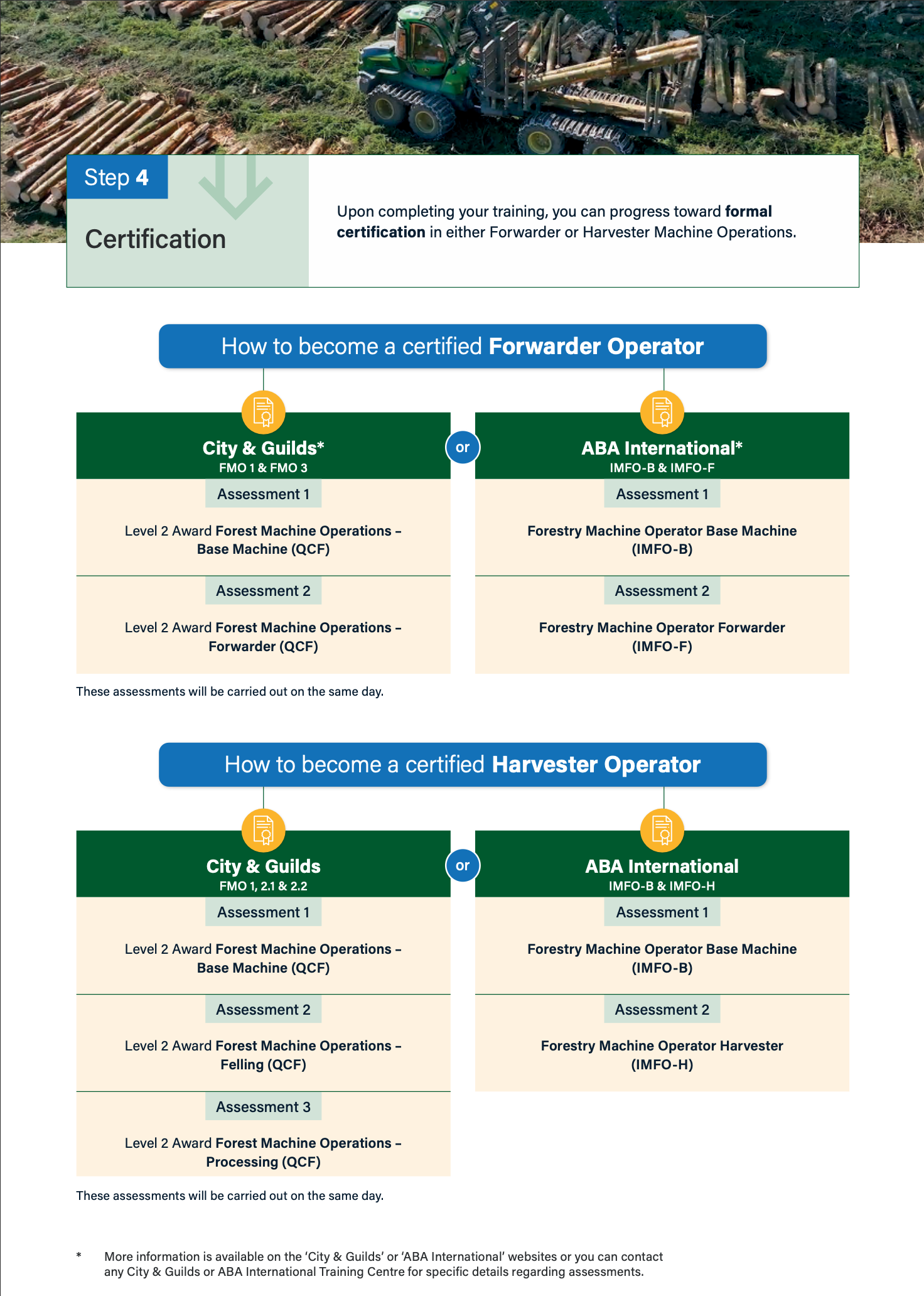
Step 4: Certification
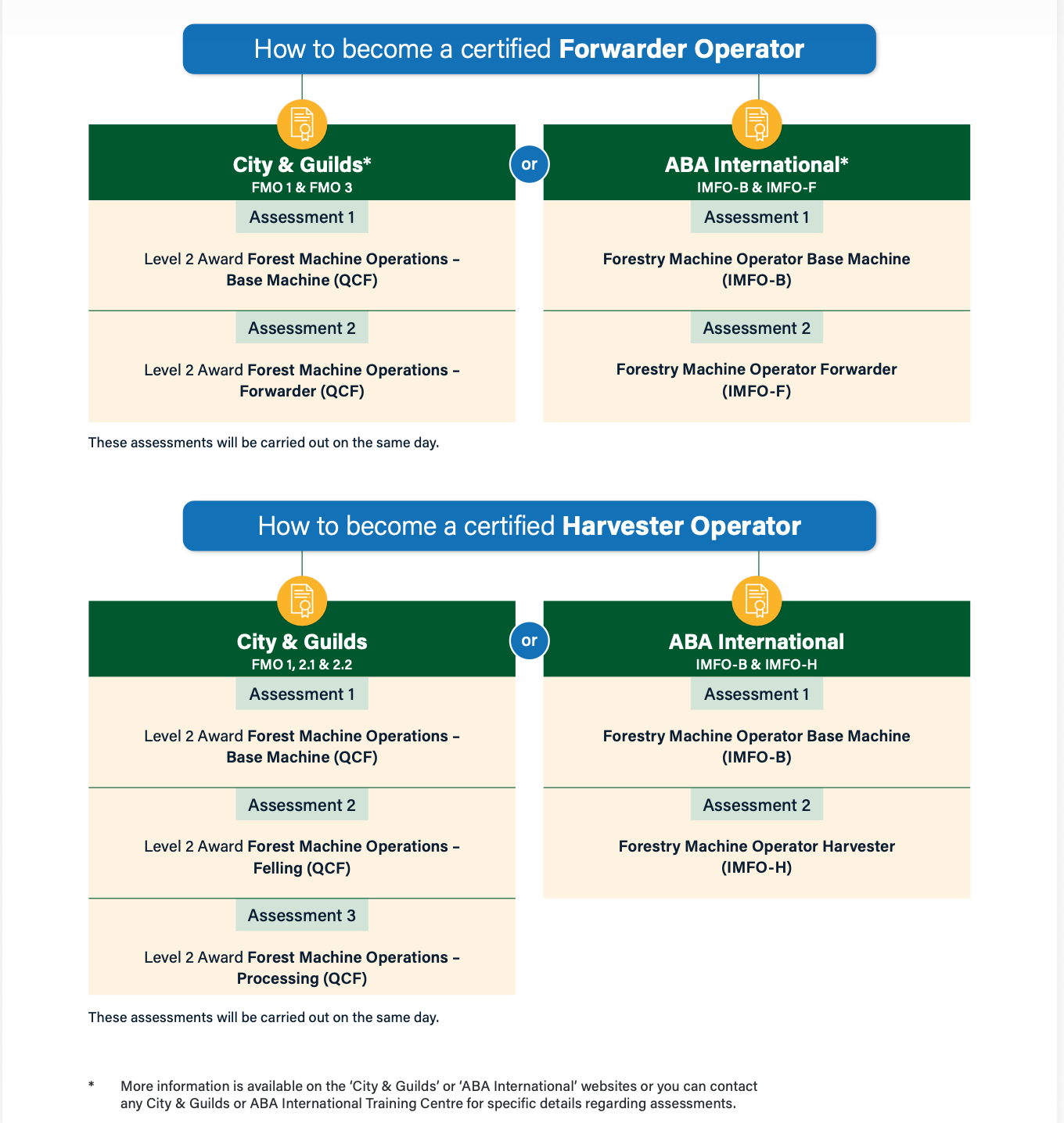
Upon completing your training, you can progress toward formal certification in either Forwarder or Harvester Machine Operations.
Pay & Salary - Forestry Machine Operator
Salary Range (thousands per year)* €26k - €46k
Pay will depend on qualifications, training and experience.
Data Source(s):
Last Updated: November, 2025
Labour Market Updates - Forestry Machine Operator
Ireland's forestry sector anticipates a shortage of skilled forestry workers, including machine operators.
Key drivers:
- Strategic plans and forecasts show a large increase in timber harvesting and the need for mechanised capacity.
- The government is funding skills training specifically for forest operator skills.
- Coillte expects to hire many more forestry workers to meet its strategic ambitions.
Useful Contacts - Forestry Machine Operator
-
Coillte
- The Irish Forestry Board, Newtownmountkennedy, Co. Wicklow
-
- Click Here
-
Department of Agriculture, Food and the Marine
-
Department of Environment, Community and Local Government
- Custom House, Dublin, D01 W6X0
- (01) 888 2000
- Click Here
-
Society of Irish Foresters
- Society of Irish Foresters, Glenealy, Co. Wicklow
-
- [email protected]
- Click Here