Videos on the Web
- Marine Tourism Business Owner (Sea Safari)- from: Youtube Search
Most commonly reported Work Activities
- Getting Information Observing, receiving, and otherwise obtaining information from all relevant sources.
- Establishing and Maintaining Interpersonal Relationships Developing constructive and cooperative working relationships with others, and maintaining them over time.
- Performing for or Working Directly with the Public Performing for people or dealing directly with the public. This includes serving customers in restaurants and stores, and receiving clients or guests.
- Communicating with Persons Outside Organisation Communicating with people outside the organisation, representing the organisation to customers, the public, government, and other external sources. This information can be exchanged in person, in writing, or by telephone or e-mail.
- Selling or Influencing Others Convincing others to buy merchandise/goods or to otherwise change their minds or actions.
- Communicating with Supervisors, Peers, or Subordinates Providing information to supervisors, co-workers, and subordinates by telephone, in written form, e-mail, or in person.
- Judging the Qualities of Things, Services, or People Assessing the value, importance, or quality of things or people.
- Performing Administrative Activities Performing day-to-day administrative tasks such as maintaining information files and processing paperwork.
- Interacting With Computers Using computers and computer systems (including hardware and software) to program, write software, set up functions, enter data, or process information.
- Identifying Objects, Actions, and Events Identifying information by categorising, estimating, recognising differences or similarities, and detecting changes in circumstances or events.
Working Life
A Marine Tourism / Sea Safari Business Owner creates and manages experiences on the water, such as wildlife watching, eco-tours, coastal cruises, snorkelling trips, kayaking adventures, and educational marine excursions.
They combine a passion for the sea with business skills, ensuring visitors enjoy safe, memorable experiences while protecting Ireland's marine environment.
The business may offer activities such as whale and dolphin watching, coastal boat tours, kayaking, and wildlife experiences, ensuring visitors enjoy safe, memorable trips while protecting Ireland's marine environment.
They plan, operate, and oversee every aspect of the business, from maintaining vessels and ensuring passenger safety to marketing tours and managing bookings.
Owners monitor weather and sea conditions daily, plan safe routes, and use their knowledge of marine wildlife and local history to create enjoyable and educational experiences for visitors. They are responsible for complying with maritime safety regulations, protecting the environment, and ensuring customers have a positive experience.
Many business owners also employ skippers, guides, or seasonal staff and work closely with tourism organisations, local businesses, harbours, and conservation groups to promote sustainable tourism.
Responsible sea safari operators follow wildlife viewing guidelines that minimise disturbance to marine animals and become ambassadors for ocean conservation by educating thousands of visitors each year.
Top 3 Tasks
- Deliver safe and enjoyable sea safari experiences.
- Manage and grow the business.
- Educate visitors about marine wildlife and conservation.
Marine Tourism Business Owners are responsible for all aspects of running a successful sea safari business, from guiding visitors to managing day-to-day operations.
Their key responsibilities include:
- Tour Operations: Plan and safely deliver sea safaris and marine tourism experiences.
- Customer Experience: Welcome visitors, lead informative tours, and provide excellent customer service.
- Business Management: Manage bookings, finances, marketing, insurance, and licences.
- Vessel Maintenance: Maintain boats, safety equipment, and operational standards.
- Wildlife & Environmental Awareness: Educate visitors about marine wildlife and promote responsible tourism.
- Health & Safety: Monitor weather and sea conditions, carry out risk assessments, and comply with maritime safety regulations.
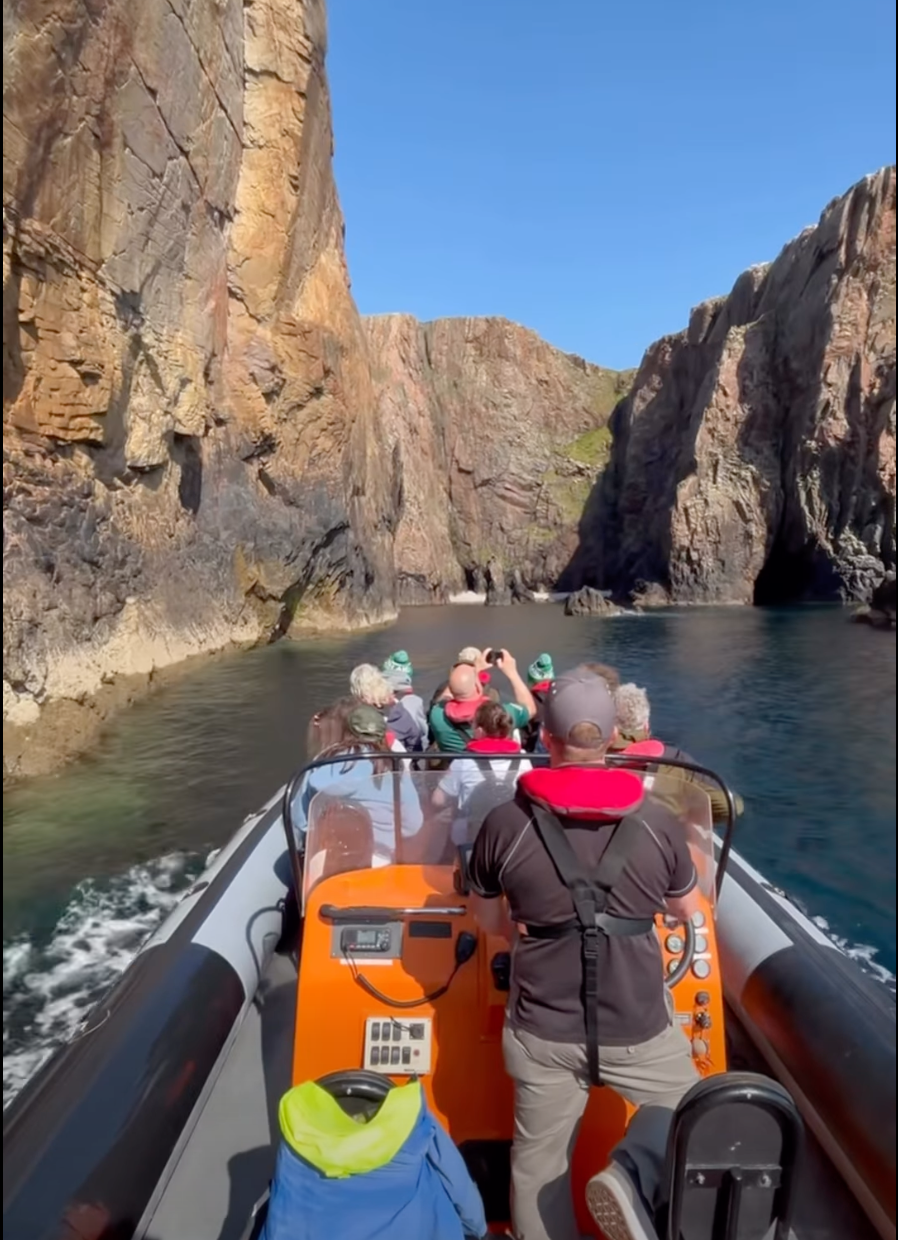
Click on the image below to see a Sea Safari trip in action at Donegal Sea Adventure
Most commonly reported Work Tasks
- Plan tour itineraries, applying knowledge of travel routes and destination sites.
- Resolve any problems with itineraries, service, or accommodations.
- Sell travel packages.
- Arrange for tour or expedition details such as accommodations, transportation, equipment, and the availability of medical personnel.
- Evaluate services received on the tour, and report findings to tour organisers.
- Lead individuals or groups to tour site locations and describe points of interest.
- Verify amounts and quality of equipment prior to expeditions or tours.
- Pay bills and record checks issued.
- Attend to special needs of tour participants.
- Give advice on sightseeing and shopping.
Qualities - Marine Tourism Business Owner (Sea Safari)
A Marine Tourism / Sea Safari Business Owner needs excellent boating and navigation skills alongside strong communication, leadership, customer service, and business management abilities.
Good knowledge of marine wildlife, weather forecasting, sea safety, and environmental protection is also essential.
Interests - Marine Tourism Business Owner (Sea Safari)
This occupation is typically suited for people with the following Career Interests:
Enterprising
Enterprising people like situations that involve using resources for personal or corporate economic gain. Such people may have an opportunistic frame of mind, and are drawn to commerce, trade and making deals. Some pursue sales and marketing occupations. Many will eventually end up owning their own business, or in management roles in larger organisations. They tend to be very goal-oriented and work best when focused on a target. Some have an entrepreneurial inclination.
Social
The Social person's interests focus on interacting with the people in their environment. In all cases, the Social person enjoys the personal contact with other people in preference to the impersonal dealings with things, data and ideas found in other groups.
Many will seek out positions where there is direct contact with the public in some advisory role, whether a receptionist or a counsellor. Social people are motivated by an interest in different types of people and like diversity in their work environments. Many are drawn towards careers in the caring professions and social welfare area, whilst others prefer teaching and other 'informing' roles.
Realist
Realists are usually interested in 'things' - such as buildings, mechanics, equipment, tools, electronics etc. Their primary focus is dealing with these - as in building, fixing, operating or designing them. Involvement in these areas leads to high manual skills, or a fine aptitude for practical design - as found in the various forms of engineering.
Realists like to find practical solutions to problems using tools, technology and skilled work. Realists usually prefer to be active in their work environment, often do most of their work alone, and enjoy taking decisive action with a minimum amount of discussion and paperwork.
Entry / Progression - Marine Tourism Business Owner (Sea Safari)
Most business owners have experience working on boats or in tourism before starting their own business.
Qualifications in maritime studies, tourism, marine biology, outdoor education, or business can all be valuable.
Professional skipper qualifications, sea safety training, and first aid certification are usually required.
There are many colleges and universities that offer degrees in tourism, business, marine science, and outdoor education that can lead to a career in marine tourism or sea safari operations. Practical maritime qualifications are also important for operating commercial passenger vessels.
The following higher education courses are particularly relevant:
- Bachelor of Business (Hons) in Tourism Management - Munster Technological University (MTU) - combines tourism, business, marketing, entrepreneurship, and visitor experience management.
- BSc (Hons) in Tourism and Event Management - South East Technological University (SETU) - focuses on sustainable tourism, digital marketing, entrepreneurship, and includes a work placement and Fáilte Ireland-recognised tour guiding certificate.
- Bachelor of Business in Tourism & Hospitality Services - SETU - develops business, tourism operations, customer service, and management skills for careers in the tourism industry.
- BSc (Hons) Marine Science - University of Galway
Develops knowledge of marine ecosystems, ocean processes, marine conservation, and fieldwork skills, which can support roles involving marine education, wildlife tours, and sustainable tourism. - BSc (Hons) Applied Freshwater & Marine Biology - Atlantic Technological University (ATU)
Focuses on aquatic ecosystems, species identification, conservation, and practical field skills relevant to marine wildlife interpretation and eco-tourism. - BA (Hons) Outdoor Education - Atlantic Technological University (ATU)
Develops skills in outdoor leadership, adventure activities, risk management, and environmental education, supporting careers in adventure and marine tourism. - BSc (Hons) Adventure Tourism Management - Atlantic Technological University (ATU)
Covers adventure activity leadership, tourism operations, sustainability, and visitor experience development, with relevance to marine adventure businesses. - BSc (Hons) Nautical Science - National Maritime College of Ireland (NMCI), Cork
Provides professional maritime knowledge including navigation, vessel operations, safety, and maritime regulations, relevant for those progressing towards commercial skipper roles. - Bachelor of Business (Hons) - various Irish universities and technological universities
Provides skills in entrepreneurship, finance, marketing, operations, and business management needed to establish and run a tourism enterprise.
Note: Marine Tourism/Sea Safari Business Owners also typically require commercial skipper qualifications, BIM Sea Safety Training, Marine Radio (SRC/VHF) certification, and First Aid qualifications before operating passenger vessels commercially.
BIM (Bord Iascaigh Mhara) delivers nationally recognised Sea Safety Training to help people develop the skills needed to work safely in Ireland's marine industries, including fishing, aquaculture and marine tourism. Training is delivered at BIM's National Fisheries College of Ireland (NFCI) and approved training centres around the country.
Key courses include:
- Personal Survival Techniques (PST) - teaches how to survive at sea, use lifejackets and life rafts, and respond to emergencies.
- Basic First Aid - provides practical skills to respond to injuries and medical emergencies onboard.
- Fire Prevention and Fire Fighting - trains participants to prevent, control and safely extinguish fires on vessels.
- Safety Awareness and Risk Assessment - develops knowledge of safe working practices, hazard identification, and accident prevention.
- Marine Radio (SRC/VHF) Training - teaches the correct use of marine VHF radios for routine and emergency communications.
These courses help skippers, crew members, and marine tourism operators meet safety requirements, build confidence at sea, and develop the essential skills needed to protect themselves, their passengers, and the marine environment.
Skills that benefit the role
- Communication: Ability to engage and educate visitors, provide clear safety briefings, and deliver enjoyable guided tours while offering excellent customer service.
- Leadership & Decision-Making: Managing a business, leading passengers and crew, assessing weather and sea conditions, and making safe, informed decisions on the water.
- Digital & Business Skills: Using online booking systems, social media, digital marketing, and customer reviews to promote the business, manage bookings, and attract visitors.
Leaving Certificate Subjects that benefit the role
- Business
- Geography
- Biology
- Information Technology
- English
- Modern Foreign Language
Sample Education and Training Pathways
A number of courses are available throughout the country that focus on learning and skills that may be useful for this career. The examples and links below may guide you in your research.
Further Education (FET)
Further Education & Training (FET) Courses are delivered by local ETBs, ranging in duration from several weeks up to 20 months. Courses are designed to meet the labour market needs and often include a large element of work experience.
Example search terms include: Tourism, Business, Marine Tourism, Guide, Tour Management, Tour Guide, Business,
Search for FET Courses
PLC Courses (FET)
PLC courses are full-time courses, one or two years duration, with awards at Level 5 and 6 on the NFQ. They are offered nationally in Schools and Colleges of Further Education.
Example search terms include: Marine, Tourism, Safety Awareness, First Aid, Business, deckhand, Skipper,
Search for PLC Courses
Apprenticeships:
Apprenticeships are structured work-based training programs that combine on-the-job training with classroom instruction. They run from 2 – 4 years and are open to individuals of all ages, including school leavers, those seeking a career change, and existing employees who wish to upskill.
Examples: Deckhand, Skipper,
Search for Apprenticeships
Higher Education CAO (Undergraduate)
Higher Education courses at Levels 6 to 8 on the NFQ, delivered in Universities and Technological Universities & Institutes. Courses run from 2 – 5 years and places are allocated on a points-based system, processed by the Central Application Office.
Example search terms include: marine biology, biology, wildlife biology, science, marine science.
Search for CAO Courses
Higher Education (Postgraduate)
Postgraduate courses are courses at Levels 9 and 10 on the NFQ and usually last 1 – 2 years full time, or longer if a PhD or part time. Entrants typically require an undergraduate award (Level 8).
Example search terms include: biology, marine biology, marine conservation, coastal and marine environments, marine sciences
Search for Postgraduate Courses
Career Pathways and Opportunities
Many Marine Tourism / Sea Safari Business Owners begin their careers as deckhands, skippers, outdoor activity instructors, dive professionals, or wildlife guides before establishing their own businesses.
With experience, operators can expand by adding larger vessels, offering specialist wildlife photography tours, kayaking or snorkelling excursions, educational school programmes, fishing charters, or luxury coastal cruises. Some diversify into accommodation, hospitality, or adventure tourism packages.
Others become recognised marine educators, consultants, or tourism ambassadors, working with organisations such as BIM, Fáilte Ireland, local authorities, conservation charities, and coastal tourism networks to promote sustainable marine tourism and develop Ireland's Blue Economy.
Entry and Training
Start Your Journey
Roles: Deckhand, tour guide, outdoor instructor, tourism assistant, trainee skipper
Time: 0-3 years
Qualifications: Boat handling experience, sea safety and first aid certificates, customer service skills, relevant maritime or tourism qualifications.
Grow Your Expertise
Roles: Qualified skipper, tour manager, operations supervisor, marine wildlife guide
Time: 3-8 years
Qualifications: Commercial skipper certification, business management experience, marketing skills, wildlife interpretation, advanced navigation, vessel operations.
Become a Business Owner
Roles: Marine tourism entrepreneur, sea safari owner, adventure tourism operator, eco-tourism business owner
Time: 8+ years
Qualifications: Strong industry experience, business planning, financial management, leadership skills, regulatory knowledge, and an established customer base.
This timeline is for illustrative purposes; actual career progression varies depending on experience, training, and opportunities.
Pay & Salary - Marine Tourism Business Owner (Sea Safari)
Salary Range (thousands per year)* €55k - €100k
Salaries in the the marine tourism industry vary by role, duties, location, shift, and experience.
Pay can be seasonal and can vary depending on the type and size of the business. Earnings differ across jobs and workplaces.
Data Source(s):
Glassdoor.ie/Indeed.ie
Last Updated: July, 2026
Labour Market Updates - Marine Tourism Business Owner (Sea Safari)
Useful Contacts - Marine Tourism Business Owner (Sea Safari)
-
Fáilte Ireland
-
Bord Iascaigh Mhara (BIM)
- Crofton House, Crofton Road, Dun Laoghaire, Co. Dublin
- (01) 214 4100
- Click Here
-
Department of Earth and Ocean Sciences NUIG
- National University of Ireland, Galway, University Road, Galway
- (091) 492126
- Click Here
-
Irish Tourism Industry Confederation
-
IMDO – Irish Maritime Development Office
- Three Park Place, Upper Hatch Street, Dublin 2, D02 FX65. Ireland
- (01) 7753900
- [email protected]
- Click Here