Work Environment
This occupation is typically found in the following Career Sector(s):


Podcasts
Irish Defence ForcesThe Military Diver
View transcriptVideos & Interviews


Videos on the Web
- Commercial Diver- from: Youtube Search
Most commonly reported Work Activities
- Performing General Physical Activities Performing physical activities that require considerable use of your arms and legs and moving your whole body, such as climbing, lifting, balancing, walking, stooping, and handling of materials.
- Inspecting Equipment, Structures, or Material Inspecting equipment, structures, or materials to identify the cause of errors or other problems or defects.
- Handling and Moving Objects Using hands and arms in handling, installing, positioning, and moving materials, and manipulating things.
- Making Decisions and Solving Problems Analysing information and evaluating results to choose the best solution and solve problems.
- Communicating with Supervisors, Peers, or Subordinates Providing information to supervisors, co-workers, and subordinates by telephone, in written form, e-mail, or in person.
- Getting Information Observing, receiving, and otherwise obtaining information from all relevant sources.
- Identifying Objects, Actions, and Events Identifying information by categorising, estimating, recognising differences or similarities, and detecting changes in circumstances or events.
- Operating Vehicles, Mechanised Devices, or Equipment Running, maneuvering, navigating, or driving vehicles or mechanised equipment, such as forklifts, passenger vehicles, aircraft, or water craft.
- Monitor Processes, Materials, or Surroundings Monitoring and reviewing information from materials, events, or the environment, to detect or assess problems.
- Evaluating Information to Determine Compliance with Standards Using relevant information and individual judgment to determine whether events or processes comply with laws, regulations, or standards.
Working Life
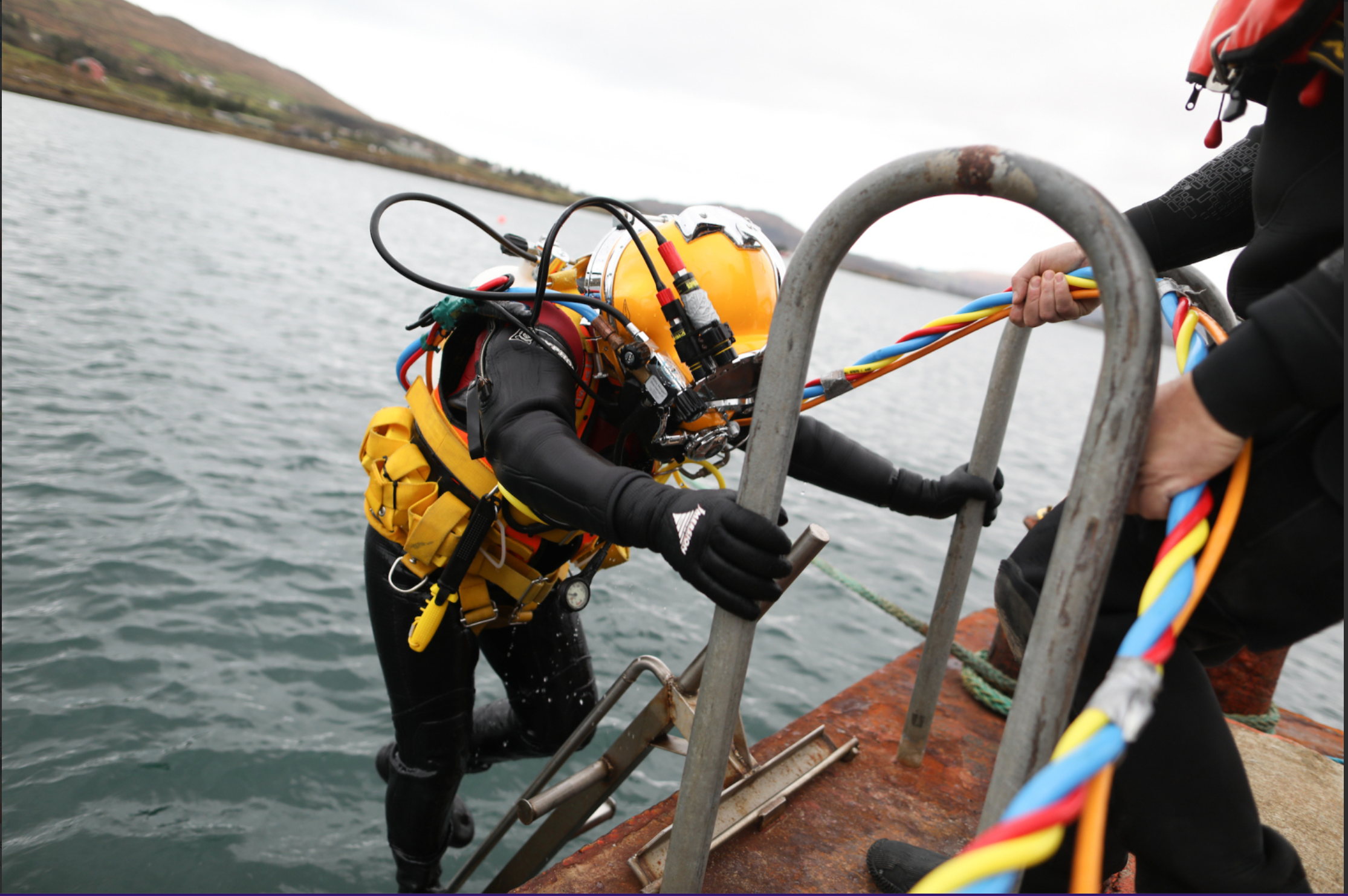

Commercial Divers are trained and medically certified to undertake high-risk underwater work such as installation, inspection, repair or welding of equipment; salvage, construction, or pipeline operations; marine research and documentation; and search & rescue.
They may work as:
- Offshore Divers – working on oil, gas, and renewable energy installations
- Onshore Divers – supporting civil engineering, harbour, inspection, and construction work
- Naval Divers – operating within the Irish Naval Service
- HAZMAT Divers – working with Garda Water Unit, Ciil Defence, or specialist teams in hasardous environments
- Scientific Divers – supporting marine reseach, surveying, and environmental monitoring.
- Media/Commercial Film Divers – assisting in underwater photography, filming, and documentary production.
Surface-supplied diving is the main method used for commercial work (fish farms, inspections, civil engineering). The diver is linked to the surface by an umbilical hose that provides air, communication, and power for safety and longer, deeper dives.
SCUBA diving uses air cylinders carried by the diver. It is mostly used for training or short, shallow tasks.
Aquaculture Divers
-Divers play an important role on fish farms, they are the eyes of management under the water and report on the condition of fish, nets and mooring systems.
-Fish farms need divers to remove dead fish from the bottom of the cages to prevent disease and assist in net changing and in-water net cleaning operations.
-Divers carry out regular mooring surveys and inspections, checking for wear on chains and vital components.
-The work can be very demanding and divers can spend many hours in the water each day.
-Only certified commercial divers may work in aquaculture, ensuring the highest standards of safety and care for both people and fish. Major diving locations include Donegal, Cork, Kerry, Galway, Mayo, Waterford, and Wexford.
BIM (Bord Iascaigh Mhara) offers QQI-accredited commercial diving courses in Ireland (Scuba and Surface-Supplied) at its National Fisheries College, approved under Irish diving legislation to meet industry demand.

The following competences are required to work as a commercial diver:
Physical fitness — Must be in very good health
Medical fitness — Needs a valid certificate of medical fitness to dive issued by an Approved Medical Examiner of Divers (AMED), renewed at least annually. See HSA.ie for more details and a list of AMEDs.
Swimming ability — Basic competence in swimming is required (e.g., for entry into commercial diving courses in Ireland you must be able to swim ~200m).
Training & competence — Needs formal training (knowledge, experience) in commercial diving methods (e.g., surface-supplied or scuba), as aligned with Irish regulations.
Technical skills — Ability to use underwater tools, perform inspections, rigging, welding, or other job-specific equipment.
Teamwork & communication — Must work effectively with a dive team and communicate clearly during operations.
Safety awareness — High regard for health & safety procedures, risk assessment, and adherence to diving regulations.
First aid & emergency response — Understanding of first-aid, rescue protocols, and decompression chamber operations.
Resilience & adaptability — Should cope with challenging and potentially unpredictable underwater environments.
Most commonly reported Work Tasks
- Take appropriate safety precautions, such as monitoring dive lengths and depths and registering with authorities before diving expeditions begin.
- Check and maintain diving equipment, such as helmets, masks, air tanks, harnesses, or gauges.
- Communicate with workers on the surface while underwater, using signal lines or telephones.
- Descend into water with the aid of diver helpers, using scuba gear or diving suits.
- Obtain information about diving tasks and environmental conditions.
- Supervise or train other divers, including hobby divers.
- Inspect the condition of underwater steel or wood structures.
- Inspect and test docks, ships, buoyage systems, plant intakes or outflows, or underwater pipelines, cables, or sewers, using closed circuit television, still photography, and testing equipment.
- Repair ships, bridge foundations, or other structures below the water line, using caulk, bolts, and hand tools.
- Recover objects by placing rigging around sunken objects, hooking rigging to crane lines, and operating winches, derricks, or cranes to raise objects.
Further Information
- Diver- from: N.C.S. [UK]
Qualities - Commercial Diver
Diving is highly skilled work. Commercial diving requires strong personal discipline and the ability to work safely in demanding conditions. You must pass a strict medical, stay calm under pressure, work well in a team, and use initiative when needed.
The job calls for technical skill, scientific or mechanical know-how, and confidence using a wide range of tools, along with the resilience to handle extreme environments.
Qualities Needed to Be a Commercial Diver
- Excellent physical fitness
- Certified medical fitness to dive (AMED)
- Strong mental fitness and ability to stay calm under pressure
- Good swimming ability
- Required training and competence in commercial diving methods
- Strong technical skills with tools, equipment, and underwater tasks
- Effective teamwork and communication
- High safety awareness and adherence to regulations
- First-aid and emergency-response competence
- Good problem-solving ability
- Strong situational awareness
- Resilience, reliability, and ability to work in harsh environments
- Good manual dexterity and coordination
- Ability to follow procedures and maintain discipline under strict safety rules
Interests - Commercial Diver
This occupation is typically suited for people with the following Career Interests:
Realist
Realists are usually interested in 'things' - such as buildings, mechanics, equipment, tools, electronics etc. Their primary focus is dealing with these - as in building, fixing, operating or designing them. Involvement in these areas leads to high manual skills, or a fine aptitude for practical design - as found in the various forms of engineering.
Realists like to find practical solutions to problems using tools, technology and skilled work. Realists usually prefer to be active in their work environment, often do most of their work alone, and enjoy taking decisive action with a minimum amount of discussion and paperwork.
Investigative
The Investigative person will usually find a particular area of science to be of interest. They are inclined toward intellectual and analytical activities and enjoy observation and theory. They may prefer thought to action, and enjoy the challenge of solving problems with sophiscticated technology. These types prefer mentally stimulating environments and often pay close attention to developments in their chosen field.
Administrative
Administrative people are interested in work that offers security and a sense of being part of a larger process. They may be at their most productive under supervisors who give clear guidelines and while performing routine tasks in a methodical and reliable way.
They tend to enjoy clerical and most forms of office work, where they perform essential administrative duties. They often form the backbone of large and small organisations alike. They may enjoy being in charge of office filing systems, and using computers and other office equipment to keep things running smoothly. They usually like routine work hours and prefer comfortable indoor workplaces.
Entry / Progression - Commercial Diver
Training
To qualify as a professional diver in Ireland, trainees must complete an accredited commercial diving course, combining practical underwater work with theoretical training, and obtain a QQI-certified qualification.
There are two main formal commercial-diver training courses in Ireland.
The National Fisheries College of Ireland, run by Bord Iascaigh Mhara (BIM), offers QQI Level 6 programmes in:
- Commercial Scuba Diving Operations
- Surface-Supplied (Inshore) Diving Operations
Entry requirements for the courses include: a valid medical certificate (AMED), swimming ability, powerboat certificate, and first-aid.
Before (or during) training, divers must pass a diving medical by an Approved Medical Examiner of Divers (AMED)
A valid certificate of medical fitness to dive is issued by an Approved Medical Examiner of Divers (AMED), renewed at least annually. See HSA.ie for more details and a list of AMEDs.
The HSA provides regulatory guidance and safety standards for all diving operations.
Under the Safety, Health and Welfare at Work (Diving) Regulations 2018, diving contractors must assess risk and ensure divers are trained for the specific method of diving used.
Divers undergo professional training to handle all conditions, including winter dives.
In Ireland, only certified commercial divers may work in aquaculture.
It is possible for commercial divers to take specialised training (e.g., underwater photography, wet welding) as part of recognised QQI commercial‑diving courses.
Divers may work with remotely operated vehicles (ROVs) in hazardous conditions, and recreational diving-instructor courses are available separately.An aptitude for physics and electronics is needed for this.
Offshore divers may also require UK HSE-approved qualifications.
For offshore diving, Irish contractors often rely on UK HSE qualifications (e.g., HSE UK surface-supplied and bell/saturation).
These courses should align with HSA Health & safety authority Diving guidelines.
Codes of Practice
Additionally, the Garda and Defence Forces provide internal training for their own personnel, but these are not part of the commercial diving training pathway regulated by the HSA or QQI.
Diving Ireland is the national governing body for recreational underwater sports in Ireland. To view a map of dive sites around Ireland, visit Diving Ireland Dive Sites .
Sample Education and Training Pathways
A number of courses are available throughout the country that focus on learning and skills that may be useful for this career. The examples and links below may guide you in your research.
Further Education (FET)
Further Education & Training (FET) Courses are delivered by local ETBs, ranging in duration from several weeks up to 20 months. Courses are designed to meet the labour market needs and often include a large element of work experience.
Example search terms include: engineering technology, operations, welding, fabrication.
Search for FET Courses
PLC Courses (FET)
PLC courses are full-time courses, one or two years duration, with awards at Level 5 and 6 on the NFQ. They are offered nationally in Schools and Colleges of Further Education.
Example search terms include: BIM, commercial scuba diving operations, surface supplied diving, engineering, technology, robotics, electronic technology, pre-university mechatronics.
Search for PLC Courses
Apprenticeships:
Apprenticeships are structured work-based training programs that combine on-the-job training with classroom instruction. They run from 2 – 4 years and are open to individuals of all ages, including school leavers, those seeking a career change, and existing employees who wish to upskill.
Example search terms include: Engineering, Instrumentation, Metal Fabrication Apprenticeships.
Search for Apprenticeships
Higher Education CAO (Undergraduate)
Higher Education courses at Levels 6 to 8 on the NFQ, delivered in Universities and Technological Universities & Institutes. Courses run from 2 – 5 years and places are allocated on a points-based system, processed by the Central Application Office.
Example search terms include: automation, robotics, automated systems, intelligent devices, electronic, engineering, physics, instrumentation.
Search for CAO Courses
Professional Development
Professional development (CPD) courses are specialised training, formal education, or advanced professional learning that improves skills, professional knowledge, competency, and overall effectiveness in the professional world.
BIM (An Board Iascaigh Mhara) National Fisheries College
HSA Health & Safety Authority of Ireland Diving
Refer to the Useful Contacts tab on this page to identify any professional bodies that may provide training for this career.
Pay & Salary - Commercial Diver
Salary Range (thousands per year)* €26k - €59k
Salaries vary by employer, role, duties, location, shift pattern, and experience.
Salaries in fishing and the marine industries vary by role, duties, location, shift, and experience. Pay can include a base wage, a share of the catch, or depend on vessel type, size, and the organisation, so earnings differ across jobs and workplaces.
Data Source(s):
Indeed / Morgan McKinley/ WRC
Last Updated: March, 2024
Labour Market Updates - Commercial Diver
Useful Contacts - Commercial Diver
-
Public Appointments Service
- Chapter House, 26/30 Abbey Street Upper, Dublin 1, D01 C7W6
- (01) 858 7400 or Local: 1890 44 9999
- [email protected]
- Click Here
-
International Marine Contractors Association (IMCA)
- Carlyle House, 235 Vauxhall Bridge Road, London SW1V 1EJ
- +44 (0)20 7824 5520
- [email protected]
- Click Here
-
Irish Underwater Council
- 78A Patrick Street, Dun Laoghaire, Co. Dublin
- (01) 2844601
- [email protected]
- Click Here
-
Professional Diving Academy
- Unit 19, Sandbank Business Park, Highland Avenue, Dunoon PA23 8PB
- 01369 701701
- [email protected]
- Click Here