

Course Summary
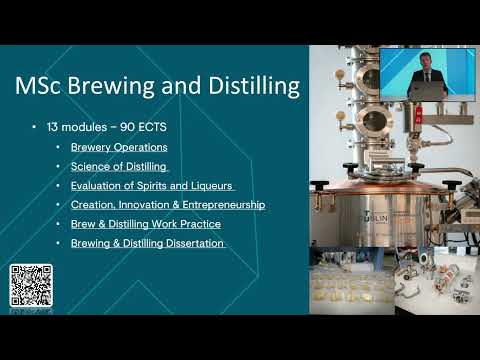
Have you an interest in Brewing and Distilling? Whether you have experience working in this sector or are completely new to this area, this programme allows participants to obtain a formal qualification for future employment in the drinks industry in Ireland or abroad. It includes modules on the technical aspects of brewing and distilling, appreciation of spirits and beers, beverage analysis, microbiology and regulation and the opportunity to acquire hands-on practical experience in these disciplines.
College Link

Career Sectors
This course prepares you for working in the Career Sectors below. Follow the links to get a fuller understanding of the sectors you are preparing for.
Entry Requirements
Minimum Entry Requirements?
Level 8 (NFQ) or higher degree in Science, Food, Engineering or Business.
Candidates with other equivalent qualifications and/or relevant industrial experience combined with suitable prior learning, both academic and professional, may be considered if deemed appropriate by the TU Dublin RPL Policy.
Or international equivalent as deemed appropriate by TU Dublin.
If English is not your first language you will need to provide evidence of your English language proficiency as detailed on our website.
Application Details
The Student
Career Interests
This course is typically suited for people with the following Career Interests. If these interests do not describe you, this course may prepare you for work you may not find satisfying.
Naturalist
Not surprisingly, some aspect of the natural sciences will run through the Naturalist's interests - from ecological awareness to nutrition and health. People with an interest in horticulture, land usage and farming (including fish) are Naturalists.
Some Naturalists focus on animals rather than plants, and may enjoy working with, training, caring for, or simply herding them. Other Naturalists will prefer working with the end result of nature's produce - the food produced from plants and animals. Naturalists like solving problems with solutions that show some sensitivity to the environmental impact of what they do. They like to see practical results and prefer action to talking and discussing.
Realist
Realists are usually interested in 'things' - such as buildings, mechanics, equipment, tools, electronics etc. Their primary focus is dealing with these - as in building, fixing, operating or designing them. Involvement in these areas leads to high manual skills, or a fine aptitude for practical design - as found in the various forms of engineering.
Realists like to find practical solutions to problems using tools, technology and skilled work. Realists usually prefer to be active in their work environment, often do most of their work alone, and enjoy taking decisive action with a minimum amount of discussion and paperwork.
Career Progression
Brewer
Cellar Brewer
Distiller
Beverage Technician
Cellar Manager
Beverage Quality Controller
Laboratory Technician
Beverage Entrepreneur
Innovation Specialist
New Product Development Scientist
Maltster
Packaging Operative
Keg Operative
Process Operative
Duration
Schedule
Delivery of this MSc. Not all of the designated weeks outlined in Figure 1 will have laboratory practicals, and hybrid lectures will be delivered (in-class, live-streamed and recorded) where possible. The work practice module (6 weeks or 30 days) can be taken part-time in semester 1 and/or semester 2 and/or over the summer months.
Semester 1
Monday 9am-5:30pm Lectures & Labs
Tuesday 9am-5pm Research Project
Wednesday 9am-5pm Research Project
Thursday 12pm-5pm Lectures & Labs
Friday 9am-3pm Lectures & Labs
Semester 2
Monday 11am-3 pm Lectures & Labs
Tuesday 9am-5pm Research Project
Wednesday 9am-5pm Research Project
Thursday 12pm-4pm Lectures & Labs
Friday 9am-3pm Lectures & Labs