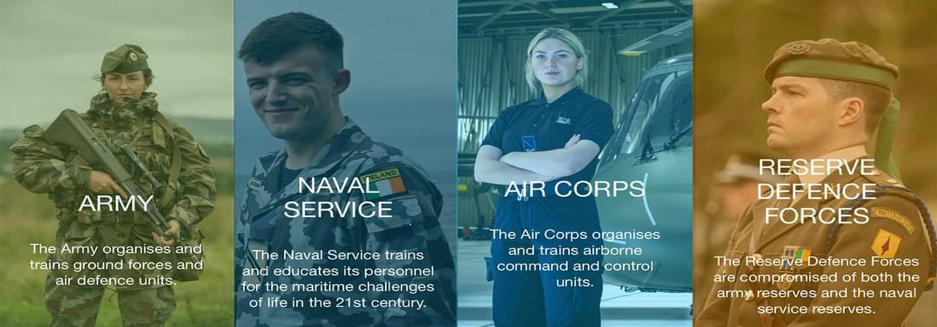
Eligibility criteria for each role varies per recruitment campaign, and so the requirements are set out in the candidate information booklet which accompanies the advertisement for the role. Qualifications can range from those of school-leavers to graduates and those at a professional level.
Teagasc education and training is centred on three core occupational roles
Manager: This role encompasses a significant business management dimension as a business owner or an employed manager.
Technician: This role involves taking responsibility for production and administration. This may be as a crop producer, livestock producer, breeder, horticulturist or an assistant manager.
Operative: The role of an operative or assistant is crucial to everyday operation. The role may be permanent or casual.
[For smaller scale units the roles are likely to be less differentiated, with owners fulfilling all roles in some cases.]
Teagasc has training and education programmes which will train you for your desired career.
The recommended education pathway for these careers is summarised in the following:
The Operative
Required Competences
Recommended Teagasc education pathway:
Level 5 Certificate.
The Technician
Required Competences
Recommended Teagasc education pathway:
Level 6 Advanced Certificate – two year pathway incorporating the Level 5 Certificate and the Level 6 Advanced Certificate.
or
Level 6 Higher Education apprenticeship programme.
The Manager
Required Competences
Recommended Teagasc education pathway:
Level 7 Higher Education apprenticeship programme
Level 7 land based higher education degree.
Teagasc is the leading provider of accredited further education for the land sector. Teagasc also has a major input into higher education and postgraduate education delivery through its extensive partnership with the higher education sector. Apprenticeship training is now available in agriculture, farm management, horticulture and sport turf management.
National policy has prioritised ‘young trained farmers’ for various farm schemes and incentives. Graduates of Teagasc training courses meet the training qualification to become a ‘young trained farmer’. Measures and schemes include:
It is expected that future CAP reform will have additional benefits for young trained farmers.
Note: Education requirements for schemes are subject to change and applicants are required to meet terms and conditions when applying for various schemes.
The life sciences industry develops products through research aimed at improving the health and well-being of both humans and animals. The qualifications required will vary significantly depending on the type of role you want to pursue. Here's a breakdown by area:
Science/Laboratory Roles: Typically, you’ll need a Level 7 or Level 8 degree in Chemistry, Biochemistry, Microbiology, or related fields. For certain positions, a doctorate may also be required. The level 6 and level 7 Lab apprenticeship are new pathways into Lab roles for more information visit. (inset link
Quality Assurance Roles: A level 7/8 degree, or master’s in chemical, mechanical, process, project, quality, or manufacturing engineering is generally necessary.
Quality Control Roles Depending on the position, you’ll typically need a level7/8 degree, or master’s in chemistry, Biochemistry, Microbiology, or a related field. Relevant lab or science experience may also be acceptable, provided you have a solid understanding of industry regulations.
Clinical Research/Clinical Trials Roles: A level 8 degree, master’s, or PhD in Chemistry, Biochemistry, Pharmacy, Pharmacology, Microbiology, or related fields is usually required. Medical doctors or those with healthcare qualifications (such as nursing) are also in demand for these roles.
Engineering Roles: These generally require a level8 degree or master’s in an engineering discipline such as chemical, mechanical, process, project, automation/instrumentation, calibration, quality, or manufacturing engineering.
Manufacturing/Production Operator Roles: In the past, these roles often didn’t require third-level qualifications, but now, many companies prefer candidates with a level5 or level 6 in a manufacturing discipline. However, requirements can vary between companies.
Validation Roles: Typically, a qualification in mechanical, process, quality, or manufacturing engineering is needed. Alternatively, a background in trades such as pipe welding or fitting, supported by a relevant certificate, may also be acceptable.
Maintenance Roles: A level 8 degree, or master’s in engineering (mechanical, automation, instrumentation, calibration, process, project, quality, or manufacturing) is usually required. For entry-level technician roles, relevant industry experience can sometimes substitute for formal qualifications.
The laboratory apprenticeships are, “earn while you learn” higher certificate and degree programmes that combine paid on the job training with academic study. These two and three-year programmes are suitable for leaving certificate students or those with an equivalent qualification, who have an interest in pursuing a career in science. The laboratory apprenticeships lead to a Level 6 Higher Certificate in Science as a Laboratory Technician and a Level 7 Ordinary Bachelor of Science Degree as a Laboratory Analyst.
Who is the apprenticeship for?
The Laboratory Apprenticeship programmes are suitable for:
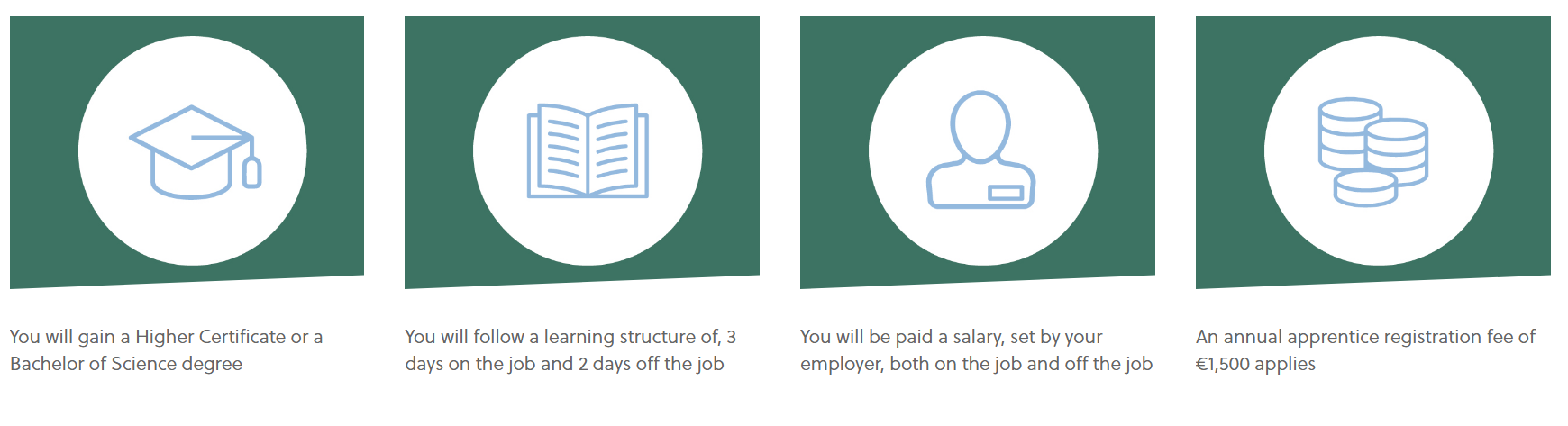
Full details on the laboratory apprenticeships can be found here.
Interviews with people working in the sector:

The industry encourages people to return to the workforce.
The basic requirements are QQI certificates in commercial fishing, aquaculture or seafood processing. BIM Safety Card, and the BIM Passenger Boat Card are extremely popular and offer dual certification. These are accredited by QQI at Level 5 and approved by the Irish Department of Transport, Tourism and Sport.
The more qualifications you hold, the more employable you will be and BIM offers a wide range of daytime, evening and weekend courses to both established fisherman and new entrants, in all areas of fishing. Education and training has a vital role to play in ensuring the long-term development of the industry.
Click on the image below for course information:

Early Years Educator
Early Years Educators provide education for children from the age of three until their transfer to primary school. They require a minimum QQI Level 5 qualification in Early Childhood Care and Education (ECCE) while Room Leaders require a minimum Level 6 on the NFQ.
Colleges of Further Education providing courses nationwide in ECCE can be found here.
A Level 7/8 degree in Early Childhood Studies / Education may also be required by some services offering the free ECCE pre-school year. Explore our CourseFinder here.
Montessori Teaching
Montessori is a method of education that is based on self-directed activity, hands-on learning and collaborative play. To work as a Montessori Teacher, an undergraduate Montessori Qualification is required, which has been taken over a minimum period of three years of full time study (or equivalent) at a minimum of Level 8 on the NFQ, and carrying at least 180 ECTS.
A list of course providers can be found here.
Applicants wishing to register with the teaching council on the basis of qualifications as a Montessori teacher must meet the qualifications requirements set out in Regulation Three of the Teaching Council Registration Regulations [click here to view].
Under Department of Education and Skills regulations, such teachers are eligible for employment as a teacher in restricted school settings, i.e. in certain categories of special schools and in certain classes in mainstream schools where Irish is not a curricular requirement.

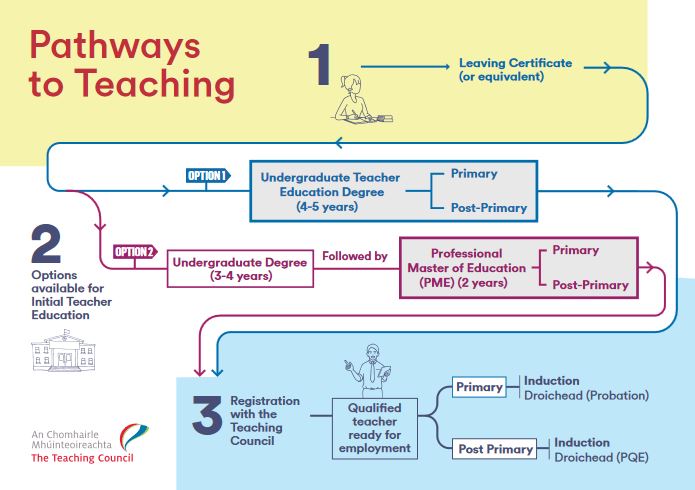
Studying to become a teacher is known as initial teacher education (ITE). You can study to be a teacher either by doing an undergraduate degree or a two-year postgraduate Professional Master of Education (PME).
There are minimum requirements in mathematics, English and Irish at Leaving Certificate. A full breakdown of the requirements can be found here.
Undergraduate - B.Ed. Programme
A full-time course leading to a Bachelor of Education degree is held in each of the state funded Colleges of Education for primary teachers. Explore CourseFinder here. Persons who successfully complete the course may then be registered with the Teaching Council.
Accredited Programmes:
Online Primary Teacher education
An online Post Graduate Masters in Education, accredited by QQI is provided by Hibernia College. Hibernia College is a privately-owned, non-state-funded, company. This blended learning course takes place over 2 years and is recognised by the Teaching Council for the purposes of primary teachingTeastas Eorpach na Gaeilge (TEG) provides a series of general Irish language proficiency examinations and qualifications for learners of Irish. Level B2 (Meánleibhéal 2) can be accepted in place of the required Leaving Cert Irish grade.
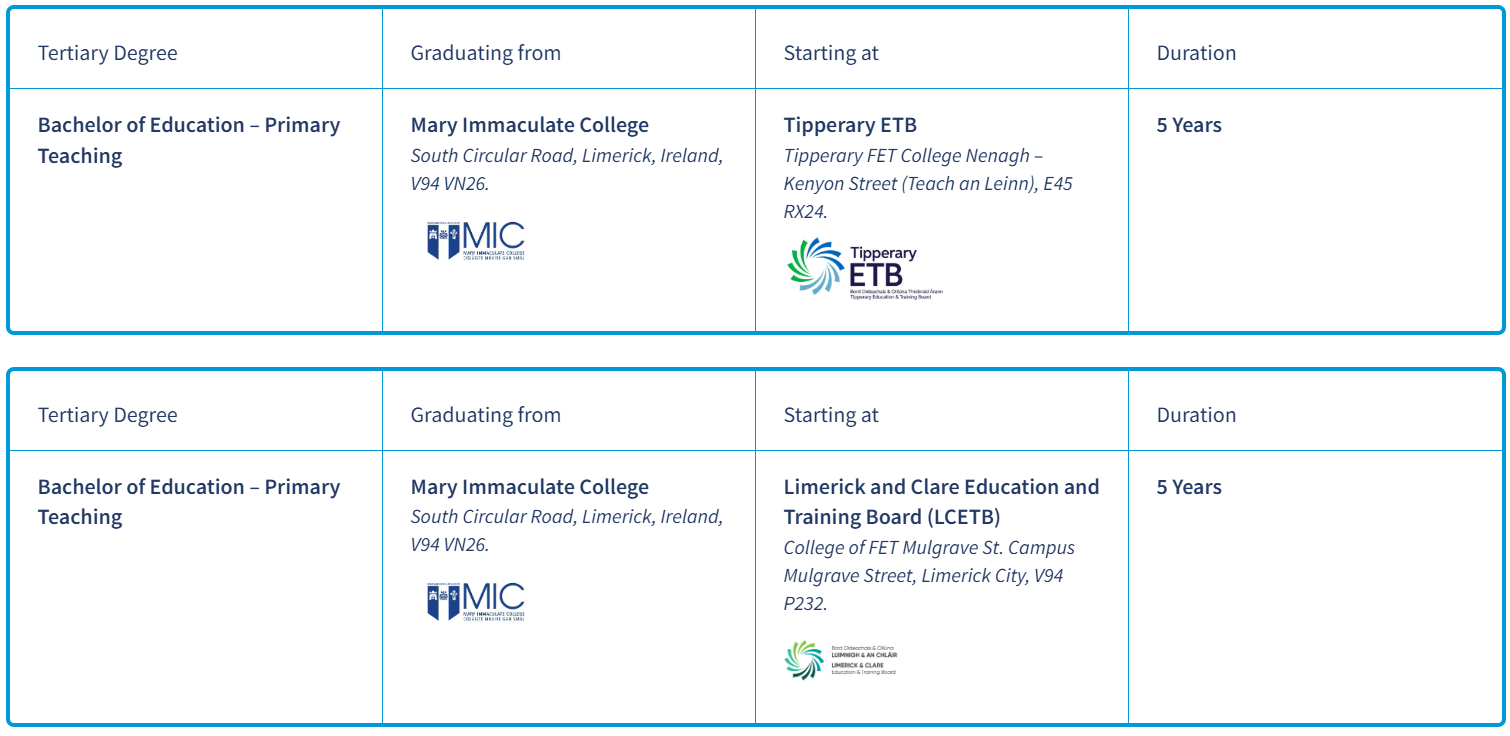
Tertiary Degree Programmes - No CAO Points needed:
Post Primary Teaching
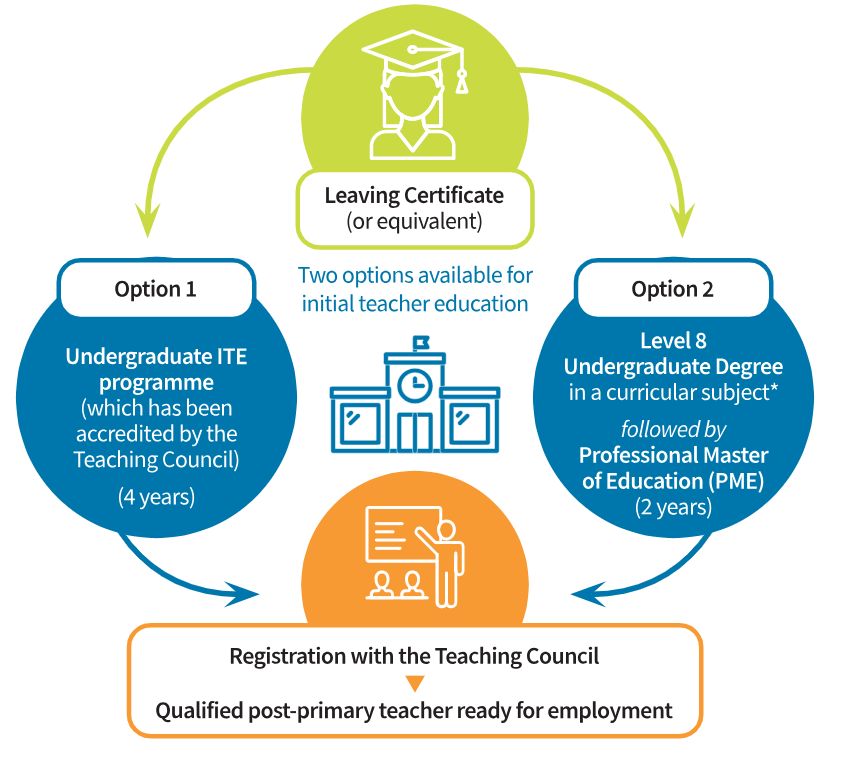
Post-primary Initial Teacher Education (ITE) is also provided on an undergraduate/concurrent or postgraduate /consecutive basis.
You can study to be a teacher either by doing an undergraduate degree (concurrent programme) or a two-year postgraduate Professional Master of Education (PME) (consecutive programme).
Applications for undergraduate ITE courses can be made through the Central Applications Office (CAO).
A full list of accredited ITE programmes can be found here.
Suitable degrees must be from a state-recognised university or similar third-level college and the content or modules in the programme must enable the holder to teach at least one curricular subject to the highest level within the post-primary school's curriculum. For most subjects, this means to Leaving Certificate Higher Level.
Suitable ITE qualifications must incorporate three specific elements:
In addition to the general entry requirements of the 3rd level institutions, there may be additional entry requirements for particular post primary teaching programmes. Please refer to the individual entry requirements for your chosen programme for more details.
The Teaching Council website provides details of the individual subject requirements (subject criteria) for all post-primary curricular subjects (i.e. English, Maths, Art, Languages etc). The Teaching Council website also provides a list of degrees deemed to meet the requirements for named curricular subjects.
Online Post Primary Teacher education
An online Post Graduate Masters in Education, accredited by QQI is provided by Hibernia College. Hibernia College is a privately-owned, non-state-funded, company. This blended learning course takes place over 2 years and is recognised by the Teaching Council for the purposes of post primary teaching.
The Teaching Council website provides details of the individual subject requirements for all post-primary curricular subjects.
It also provides a list of degrees which have in the past been deemed to meet the requirements for named curricular subjects. Because degree programmes and the elective modules within them can change over time, this list should only be considered as a guide.
| The following institutions in Ireland currently provide Post Primary Initial Teacher Education (ITE) programmes, more commonly called the Professional Master's in Education (PME): | ||
| INSTITUTION | TYPE OF PROVISION | WEBSITE |
| University College Cork (UCC) |
Concurrent & Consecutive |
www.ucc.ie |
| University College Dublin (UCD) |
Consecutive | www.ucd.ie |
|
University of Galway |
Consecutive | www.nuigalway.ie |
| Maynooth University |
Consecutive | www.nuim.ie |
| Trinity College Dublin (TCD) |
Concurrent & Consecutive |
www.tcd.ie |
| DCU Institute of Education |
Concurrent | www.dcu.ie |
| University of Limerick (UL) |
Concurrent & Consecutive |
www.ul.ie |
| National College of Art & Design (NCAD), Dublin |
Concurrent & Consecutive |
www.ncad.ie |
| MTU | Consecutive | www.mtu.ie |
| TUS | Consecutive | www.tus.ie |
| ATU | Concurrent | www.atu.ie |
| Hibernia College |
Consecutive | www.hiberniacollege.net |
Garda Vetting
All teachers must also comply with current Garda Vetting requirements - see Teaching Council Garda Vetting requirements here.
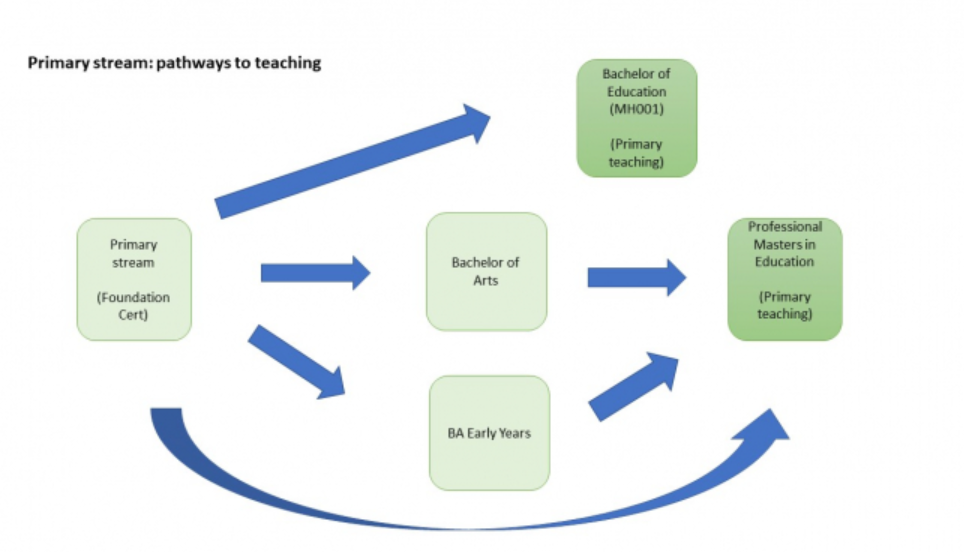
Think about Teaching is a year long foundation course for aspiring teachers run in Maynooth University. The course aims to diversify the Irish classroom by fostering a culture among students from the most educationally disadvantaged groups to consider the teaching profession as a desirable and achievable career option. The preparation course will support students academically, personally and socially; providing a pathway to degree courses within the Maynooth University in both primary and secondary education.
Possible progression routes on successful completion of the Foundation Cert:
Click here for more information.
Registration with the Teaching Council is essential for those wishing to work in State-funded teaching positions in the primary, post-primary and further education sectors as only registered teachers can be paid from State funds.
Primary Teacher Posts - these are advertised by the Boards of Management of individual schools. Selection is by interview.
Second Level Teacher Posts - Voluntary Secondary Schools and Community and Comprehensive Schools: Teaching posts are advertised by the Boards of Management of individual schools and selection is by interview. In order to be entered onto the Register of Teachers on the basis of qualifications in post-primary teaching, applicants must comply with the requirements as set out in Regulation Four of The Teaching Council [Registration] Regulations:
Candidates must hold:
Vocational schools - Teaching posts are advertised by the Education and Training Board. Teachers are appointed as teachers of a specific subject and must have a qualification to Degree level in the relevant subject area. In the past, it was not essential for a graduate to have professional teacher training.
There is no Irish language requirement for appointment as a Post-Primary teacher in the case of the majority of teachers (i.e. those who do not need to use Irish to carry out their daily duties). There is still an Irish language requirement in the case of teachers in the following categories:
1. Those employed in Gaeltacht schools
2. Those employed in schools in which Irish is the daily teaching medium (in the case of subjects other than Irish)
3. Those who teach any subject (except Irish) through Irish in any school.
Teachers in these three categories are required to hold the An Teastas Gaeilge do Mhúinteoirí Iarbhunscoile (TGMI) certified by the State Examinations Commission Exemptions, as follows, apply to those who:
Further Education covers education and training which occurs after second level schooling but which is not part of the third level system.
Qualifications required to work in this area include:
A primary degree or equivalent (not less than level 8 on the National Framework of Qualifications (NFQ) carrying at least 180 ECTS credits, AND a teacher education qualification approved by the Council for post-primary teaching (First Year to Sixth Year) or an accredited further education teacher education qualification,
OR
An ordinary degree or equivalent (not less than level 7 on the NFQ) carrying at least 180 ECTS credits, PLUS
i) an appropriate additional qualification, or
ii) certified accreditation of prior learning based on a minimum of three years’ experience in a workplace or instructional setting which is relevant to the candidate’s qualifications such as may be recognised by The Teaching Council as suitable for the purpose of registration as a teacher under this regulation which meets such requirements as the Teaching Council may publish from time to time,
AND
iii) a teacher education qualification approved by the Council for post-primary teaching (First Year to Sixth Year) or an accredited further education teacher education qualification.
The following Higher Education Institutions (HEIs) provide programmes of initial teacher education for further education.
Dublin City University (undergraduate only)
Dublin City University (undergraduate only). Show this section
Marino Institute of Education
Marino Institute of Education. Show this section
Mary Immaculate College, Limerick
Mary Immaculate College, Limerick. Show this section
Maynooth University (National University of Ireland Maynooth)
Maynooth University (National University of Ireland Maynooth). Show this section
National College of Ireland
National College of Ireland. Show this section
University of Galway
University of Galway
South East Technological University
South East Technological University (formerly Waterford Institute of Technology). Show this section
Teacher training programmes specific to this sector can be found in the 'Entry Routes' section here.
Higher Education in Ireland is provided mainly by Universities and Institutes of Technology. In general, the first appointment to an academic position at an Irish university usually is at the level of lecturer. Lecturers need a PhD degree and publications of high quality.
The career structure is generally consistent across Irish universities:
Members of staff are under the general direction of a Department Head or Professor.Posts in Colleges, Universities, Institutes of Technology or other public sector higher education institutions, are advertised and achieved by Open Competition.
Tax Advisory is a diverse and exciting career that looks to the future. On our Chartered Tax Adviser (CTA) programme you will develop the key skills and knowledge you need to be successful.
If you are looking for a career with no two days the same and are willing to learn and develop the skills of a CTA, then Tax Advisory could be for you.
The Chartered Tax Adviser (CTA) qualification is the leading tax advisory qualification in Ireland and the international gold standard in tax advice.
Delivered in three-parts, the CTA qualification builds students’ knowledge and skills from fundamentals to an advanced level. So, if you do not have a background in accounting or finance, Part 1 will catch you up on what you need to know.
All you need to join the CTA programme is a Level 8 qualification in any area.
Having a training contract with a firm is not necessary to study the CTA.
There are exemptions available for those who completed relevant level 8/9 qualifications or professional qualifications.
You can see the list of recognised exemptions at taxinstitute.ie
The Chartered Tax Adviser (CTA) programme is delivered online twice a year – summer and autumn courses. This allows students to choose when best suits them to study.
The lectures are recorded so you can watch back if you miss it live or when you’re revising.
For assessment, there are two exam sittings in a year – April/May and August. These are held online. At Part 2 and 3, there is an assignment to be completed during your studies.
Learn more about the opportunities being a Chartered Tax Adviser (CTA) offers here.
The only requirement to join the Chartered Tax Adviser (CTA) programme is a Level 8 qualification, such as an honours degree, in any discipline. See the CTA handbook for more details on routes into the programme.
It is important to know that to work and excel in Tax Advisory, you do not need:
Current CTAs come from a wide variety of backgrounds and qualifications. The diverse skillsets and qualities are required within the profession.
We offer a Third-Level Scholarship to a Leaving Cert student interested in a career in Tax Advisory who needs financial support to progress to college.
The successful scholar receives:
Applications open in spring. Learn more about the Third-Level Scholarship
“The Irish Tax Institute Third-Level Scholarship has been a transformative opportunity for me; it is something I am incredibly grateful for. The recognition as a recipient of this prestigious award has been pivotal in fostering connections and referrals as I progress with my goal of becoming a Chartered Tax Adviser. Beyond the invaluable financial support, the Irish Tax Institute’s ongoing mentorship and help has guided me throughout my college years, shaping and strengthening my career aspirations.” – Alisha Scollan, 2022 Scholarship Winner
We encourage you to see if Tax Advisory would suit you. There are many opportunities for you to encounter the profession before final year of college.
In your first few years of college:

There are many firms that offer trainee positions on their grad programmes. For the larger firms, applications typically open in September and close mid-October. Although keep an eye out all year long for other opportunities to apply.
Revenue created a Transition Year (TY) module to encourage tax to explored in schools. There are teacher notes and other materials to support the delivery of the module.

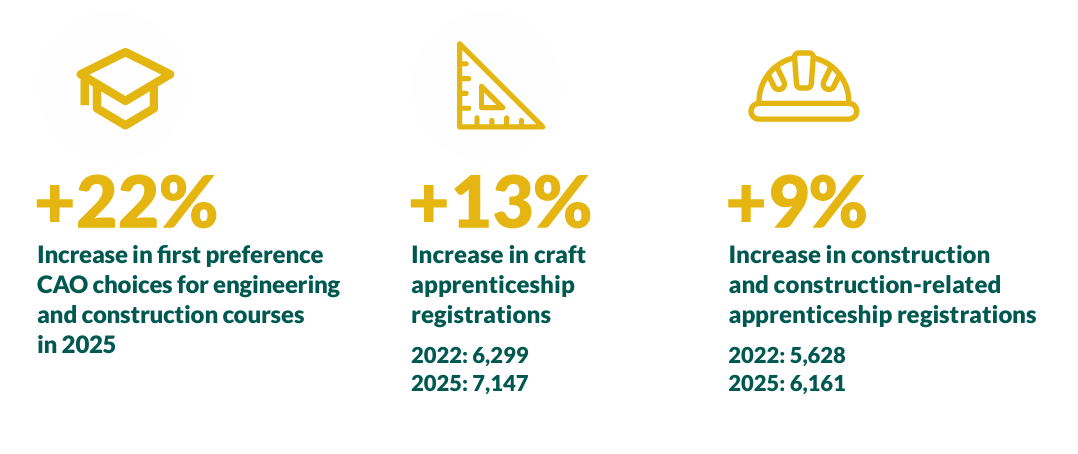
Entry into the construction sector is possible at all levels. General operatives join the industry with no experience but through working with others and on various projects, they gain skills informally and can progress to supervisory roles.
Traineeships
General Operative (GO) trainee programmes are now available through Education and Training Boards (ETB's) around the country. For example colleges such as Ballyfermot Training Centre now offer short courses in areas such as Steel Fixing, Form Work, Flooring and GO training. Courses in other ETB's include Glazing and Roofing. These traineeships could be up to 18 months in duration.
To check out all the ETBs around the country click here.
The Mount Lucas National Construction Training Centre specialises in construction related skills including Utilities Traineeship, Scaffolding Apprenticeship and retrofitting skills.
The Centre, located in Daingean, Co. Offaly is designed to train, develop and upskill the competencies for both construction machine operators and operatives that will enable trainees to develop a career within the construction industry.
Other programmes on offer at Mount Lucas include:
Apprenticeship
Apprenticesips are four year earn and learn programmes which qualify you to work in the construction industry.
You can search apprenticeship jobs here filtering by location and apprenticeship type

Apprentices must meet minimum entry requirements set down by SOLAS. POTENTIAL APPLICANTS TO ELECTRICAL TRADE BE WARNED! - MOST EMPLOYERS IN THIS SECTOR WILL ONLY ACCEPT APPRENTICES WHO HAVE COMPLETED THEIR LEAVING CERTIFICATE MATHS.
School Leavers
School leavers wishing to qualify as engineers / surveyors should check with their chosen college to ascertain the entry requirements. New entrants to the construction sector arrive from a variety of backgrounds and have a range of prior formal qualifications, such as Leaving Certificate or equivalent.
Third Level Qualifications
Degrees in all disciplines are welcomed for those wishing to work in the construction sector. There is always a requirement for highly skilled graduates. Many of those working in the sector will have come from a range of academic backgrounds such as:
CIF Learning and Development provides a wide range of training programmes for the construction sector:
The range of current courses available include:
Life long learning is an important aspect to continuing progression within the sector.
All workers in the industry must have completed Safe Pass.
Army Recruit - Soldier
Army Equitation School Groom
Dental Surgery Attendant Army (Direct Entry)
Dental Surgery Hygienist Army (Direct Entry)
Army Bands Instrumentalist (Direct Entry)
Army Medical Officer (Direct Entry) A candidate must: (a) Possess the minimum qualifications of M.B., B.Ch., B.A.O., or L.R.C.P. and S.I. (b) Hold current, full registration with the Medical Council of Ireland. (A successful candidate will be required to maintain registration). (c) Have 3 years post graduate experience. In addition, it is desirable but not essential that candidates be entered on one of the following Specialist Register of the Medical Council of Ireland:
Army Dental Officer (Direct Entry) A candidate must: (a) Possess a degree or licence in dental surgery from a University or recognised licensing body. (b) Be registered in the Dental Register of the Irish Dental Council. (A successful candidate will be required to maintain registration). (c) Have three (3) years post graduate experience.
Army Pharmacist Officer (Direct Entry) A candidate must: (a) Possess the qualifications of B.Sc. Pharm. (b) Be a member of the Pharmaceutical Society of Ireland. (A successful candidate will be required to maintain registration). (c) Have three (3) years post graduate experience.
Army Psychiatrist Officer (Direct Entry) A candidate must: (a) Possess the minimum qualifications of MRC Psych. or equivalent. (b) Hold current, full registration with the Medical Council of Ireland. (A successful candidate will be required to maintain registration). (c) Be entered on, or eligible to be entered on, the Specialist Register division of Psychiatry of the Medical Council of Ireland.
Army Clinical Psychologist Officer A candidate must: (a) Possess the minimum qualifications of MSc or MA in Clinical Psychology or equivalent. (b) Who has experience in one-to-one psychotherapeutic intervention in trauma cases is desirable.
Army Engineer Officer (Direct Entry) A candidate for appointment as Engineer Officer in the Corps of Engineers must hold a third level Degree recognised for corporate membership of the Institution of Engineers of Ireland, or the Royal Institute of Architects of Ireland in one of the following subjects:
Army Ordnance Officer (Direct Entry) A candidate for appointment as Ordnance Officer in the Ordnance Corp must hold a third level Degree in either:
Defence Forces Recruitment Fitness Standards

The Physical Fitness test is designed to assess the candidate’s current level of physical fitness and his/her capacity to undergo the rigours of military training. It is composed of three aspects.
Click here to see our full fitness test requirements.
Officer Cadetship – Army/Equitation School
School Leaver/Non-Graduate Candidates
Must possess a minimum of Grade H5 in 3 Higher Level papers, and, Grace O6 in 3 Ordinary Level papers or Grade H6 in 3 Higher Level papers.
*Candidates must have obtained these grades in a single sitting of the Leaving Certificate examination for COA computation purposes
AND
A candidate’s educational qualifications must include a minimum of Grade O6 at Ordinary Level or Grade H6 at Higher Level in the following subjects:
Subject to meeting the criteria to have obtained a minimum of Grade H5 in 3 Higher Level papers, and, Grade O6 in 3 Ordinary Level papers or Grade H6 in 3 Higher Level papers, a candidate may use the results of another sitting of the Leaving Certificate for the minimum educational requirements in (i) to (iv) above.
Graduate Candidates
Must have successfully completed a Bachelor Degree programme at Level 8 of the National Framework of Qualifications.
*Please not that applicants for the Army (Equitation School) do not required a third language accepted for NUI Matriculation Registration purposes.
Air Corps Recruit - Airman
Air Corps Apprentice
Candidates must have attained the required minimum educational qualifications at the time of entry into the Air Corps.
Candidates must have a Leaving Certificate with at least five subjects, including mathematics and one science subject. This criteria is subject to change in line with each competition’s Terms and Conditions.
All students will be registered with SOLAS and on successful completion of the requirements set out in the Aircraft Mechanic curriculum will be awarded a National Craft Certificate.
Officer Cadetship – Air Corps
School Leaver/Non-Graduate Candidates
Must possess a minimum of Grade H5 IN 3 Higher Level papers, and, Grade O6 in 3 Ordinary Level paper or Grade H6 in 3 Higher Level papers.
Candidates must have obtained these grades in a single sitting of the Leaving Certificate examination for CAO computation purposes.
AND
A candidate’s educational qualifications must include a minimum of:
(i) Grade O3 in Mathematics in an Ordinary Level paper or Grade H6 in a Higher Level Paper
and
(ii) Grade O6 at Ordinary Level or H6 at Higher Level in the following subjects:
(i)Irish. NUI matriculation exemptions apply.
(ii) English. Candidates whose first language is not English must satisfy the English language requirements in accordance with NUI Matriculation Regulations.
Subject to meeting the criteria to have obtained a minimum of Grade H5 in 3 Higher Level papers and Grade O6 in 3 Ordinary Level papers or Grade H6 in 3 Higher Level papers, a candidate may use the results of another sitting of the Leaving Certificate for the minimum educational requirements in (i) to (ii) above.
Graduate Candidates
Must have successfully completed a Bachelor Degree programme at Level 8 of the National Framework of Qualifications.
Naval Service Recruit - Seaman
Officer Cadetship – Naval Service
Naval Service – Operations Branch
School Leaver or Non-Graduate Candidates
Must possessa minimum of Grade H4 in 4 Higher Level papers, and, Grade 02 in 2 Ordinary Level Papers or Grade H6 in 2 Higher level papers.
Candidates must have obtained these grades in a single sitting of the Leaving Certificate examination for CAO computation purposes.
AND
A candidate’s educational qualifications must include a minimum of Grade 06 at Ordinary level or H6 at Higher Level in the following subjects:
(i) Mathematics.
(ii) Irish. NUI matriculation exemptions apply.
(iii) English. Candidates whose first language is not English must satisfy the English language requirements in accordance with NUI Matriculations Regulations.
Subject to meeting the criteria to have obtaineda minimum of Grade H4 in 4 Higher Level papers, and, Grade O2 in 2 Ordinary level papers or Grade H6 in 2 Higher level papers, a candidate may use the results of another sitting of the Leaving Certificate for the minimum educational requirements in (i) to (iii) above.
Where a School Leaver applicant has undertaken / is undertaking a field of study in Nautical Science at Level 7 (or below) of the NFQ, they may be facilitated in continuing their training to complete their field of study in Nautical Science at Level 7 of the NFQ in a college nominated by the Flag Officer Commanding Naval Service.
Where an School Leaver applicant has undertaken / is undertaking a Level 8 (or below) NFQ qualification not specified above, they may seek a determination that the course of study meets the requirements subject to submitting, suitable evidence of equivalence, to Defence Forces Recruitment Section, Defence Forces Headquarters, Department of Defence, Station Road, Newbridge, Co. Kildare, W12 AD93, for the Flag Officer Commanding Naval Service’s determination.
Graduate Candidates
Must have successfully completed a Bachelor Degree programme at Level 8 of the National Framework of Qualifications.
OR
Have successfully completed a Bachelor Degree programme at Level 7 of the National Framework of Qualifications, from a recognised institution, in Nautical Science.
Naval Service – Marine Engineer Branch
School Leaver or Non-Graduate Candidates
Must possess a minimum of H5 in 3 Higher Level papers, and, a minimum of Grade O4 in 3 Ordinary Level papers or Grade H6 in 3 Higher Level papers.
Candidates must have obtained these grades in a single sitting of the Leaving Certificate examination for CAO computation purposes.
AND
A candidate’s educational qualifications must include:
(i) Mathematics. Minimum of Grade 02 in an Ordinary Level Paper or Grade H6 in a Higher Level paper.
(ii) Irish. Minimum Grade O6 in an Ordinary Level paper or Grade H6 in a Higher Level paper. NUI matriculation exemptions apply.
(iii) English. Minimum Grade O6 in an Ordinary Level paper or Grade H6 in a Higher Level paper. Candidates whose first language is not English must satisfy the English language requirements in accordance with NUI Matriculations Regulations.
Subject to meeting the criteria to have obtaineda minimum of Grade H5 in 3 Higher Level papers, and, a minimum of Grade O4 in 3 Ordinary Level or Grade H6 in 3 Higher Level papers, a candidate may use the results of another sitting of the Leaving Certificate for the minimum educational requirements in (i) to (iii) above.
Where a School Leaver applicant has undertaken / is undertaking an engineering programme in Marine Engineering at Level 7 (or below) of the NFQ, they may be facilitated in continuing their training to complete an engineering programme in Marine Engineering at Level 7 of the NFQ in a college nominated by the Flag Officer Commanding Naval Service.
Where an School Leaver applicant has undertaken / is undertaking a Level 8 (or below) NFQ qualification not specified above, they may seek a determination that the course of study meets the requirements subject to submitting, suitable evidence of equivalence, to Defence Forces Recruitment Section, Defence Forces Headquarters, Department of Defence, Station Road, Newbridge, Co. Kildare, W12 AD93, for the Flag Officer Commanding Naval Service’s determination.
Graduate Candidates
Must have successfully completed a Bachelor Degree programme at Level 8 of the National Framework of Qualifications.
OR
Have successfully completed a Bachelor Degree programme at Level 7 of the National Framework of Qualifications, from a recognised institution, in Marine Engineering.
Naval Service - Electrical Engineering Branch
School Leaver or Non – Graduate Candidates
Must possess a minimum of Grade H4 in 4 Higher Level papers, and, a minimum of Grade 02 in 2 Ordinary Level papers or Grade H6 in 2 Higher Level papers.
Candidates must have obtained these grades in a single sitting of the Leaving Certificate examination for CAO computation purposes
AND
A candidate’s educational qualifications must include the following:
(i) Mathematics. Minimum of Grade H5 in a Higher Level paper.
(ii) Irish. Minimum Grade O6 in an Ordinary Level paper or Grade H6 in a Higher Level paper. NUI matriculation exemptions apply.
(ii) English. Minimum Grade O6 in an Ordinary Level paper or Grade H6 in a Higher Level paper. Candidates whose first language is not English must satisfy the English language requirements in accordance with NUI Matriculations Regulations.
Subject to meeting the criteria to have obtained a minimum of Grade H4 in 4 Higher Level papers, and, a minimum of Grade 02 in 2 Ordinary Level papers or Grade H6 in 2 Higher Level papers, a candidate may use the results of another sitting of the Leaving Certificate for the minimum educational requirements in (i) to (iii) above.
Where a School Leaver applicant has undertaken / is undertaking an engineering programme in Electrical / Electronic Engineering at Level 8 (or below) of the NFQ, they may be facilitated in continuing their training to complete an engineering programme in Electrical / Electronic Engineering at Level 8 of the NFQ in a college nominated by the Flag Officer Commanding Naval Service.
Where a School Leaver applicant has undertaken / is undertaking a Level 8 (or below) NFQ qualification not specified above, they may seek a determination that the course of study meets the requirements subject to submitting, suitable evidence of equivalence, to Defence Forces Recruitment Section, Defence Forces Headquarters, Department of Defence, Station Road, Newbridge, Co. Kildare, W12 AD93, for the Flag Officer Commanding Naval Service’s determination.
Graduate Candidates
Graduate Candidatesmust have successfully completed a Bachelor Degree programme at Level 8 or higher of the National Framework of Qualifications (NFQ) in either Electrical or Electronic Engineering.
Where an applicant has a Level 8 or higher NFQ qualification not specified above, they may seek a determination that the qualification meets the requirements subject to submitting, suitable evidence of equivalence, to Defence Forces Recruitment Section, Defence Forces Headquarters, Department of Defence, Station Road, Newbridge, Co. Kildare, W12 AD93, for the Flag Officer Commanding Naval Service’s determination.
PLEASE NOTE:
Defence Forces TY
The following outlines the various training areas. Due to operational demands, TY weeks may not be available at all locations. Each recruitment office will advise school career guidance councillors where and when these TY weeks are scheduled.
Please note that inquiries about scheduled dates and placements will only be accepted by school career guidance counsellors, not individuals.
ARMY
1 Bde: Cork, Limerick, Kilkenny, Galway.
Phone: (021) 451 4108. Email: [email protected]
2 Brigade: Athlone, Dublin, Dundalk, Donegal,
Phone: (01) 804 6453 Email: [email protected]
Defence Forces Training Center Curragh Camp: Kildare
Phone: (045) 44 5021 Email: [email protected]
NAVAL SERVICE
Naval Base, Cobh, Co Cork
Phone: 021 4864732 Email: [email protected]
AIR CORPS
Casement Aerodrome, Baldonnel, Co Dublin
Phone: 01 4037821 Email: [email protected]
All positions within the Irish health sector have minimum qualifications attached to them. Certain professions, such as nursing, medicine and therapies, require that you study and qualify in that particular area.
However, there are many positions within the health sector with very varied qualifications, therefore there really is something for everybody.
There is a great focus on training and development for staff in the HSE and there is ample opportunity to progress from an entry level position and build your career within the health service.
To check out the eligibility criteria for many positions in the HSE, please click here. All positions are advertised on www.hse.ie and job specifications will outline the minimum qualifications required for that particular post.
The most usual route is through taking a degree at a third level college, often following this with a post graduate qualification.
Some courses offer work placements during the programme which is particularly beneficial in obtaining employment after completing the degree.
Higher certificate courses (level 6) and ordinary degree programmes (level 7) are also available often in areas such as instrumentation. These can lead to good jobs as lab technicians with many opportunities for further progression in companies who support additional learning.
For more information about the qualifications that are required click here