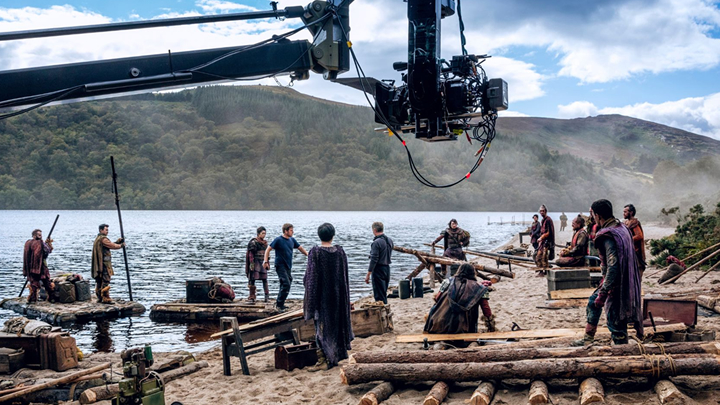
Some people working in the sector may have completed a PLC course, others will have gone through the college/university route and graduated with an undergraduate degree specialising in a particular area, while some people may have never studied at third level prior to working in the screen industry.
For example, if you are interested in a role in a film or TV crew department, qualifications are not as important as on set experience. Whereas you would typically need to have completed a course and have built up a portfolio if you wanted to work in animation, games or VFX. Additionally, these roles typically require you to have previous knowledge of working with industry software and applications which you would gain experience through a course.
Choosing to study film or a related course in college does give you a deeper knowledge of the theory and history of film, provides you with a network of peers and professionals, and may also include an opportunity for a work experience placement.
The National Talent Academies network is an initiative of Fís Éireann/Screen Ireland.
The aim of the National Talent Academies is to address and support current educational skills gaps in the screen sector. Retaining the diversity and inclusion focus present across all Academy initiatives, its ambition is to drive more Irish talent from all backgrounds and disciplines into the sector and develop greater awareness of the sector as a career path.
Skills Development
Talent and skills development are central to the ambition for a thriving screen sector in Ireland. Current government policy on education and skills, particularly in relation to the National Training Fund, is focused on industry-relevant skills development, especially work-based learning.
Third Level
Within Third Level, a number of newly funded HEA Human Capital Initiative (HCI) projects are supporting the sector. In particular, the Creative Futures Academy project (IAD T, NCAD and UCD) which designs learning experiences that allow creatives to shape their future careers and the CONVENE project (TU Dublin and UCD) which is exploring new ways that academia and enterprise can work more closely together to meet priority and emerging skills needs. In addition, the HCI projects focused on RPL (Recognition of Prior Learning) and Micro-credentials also have the potential to positively address challenges within the Screen Sector.
Skillnets
The sector is also well supported by a number of government funded Skillnet Networks including Screen Skillnet, Anim ation Skillnet, Immersive Technologies Skillnet and Gréas án Na Me án Skillnet. The Skillnet networks provide a range of subsidised and industry-focused skills development programmes and initiatives to support the development o f the wider screen. sector
Online Programmes
To support more positive work environments within the creative Industries, Screen Ireland has partnered with the Department of Tourism, Culture, Arts, Gaeltacht, Sport and Media, the Arts Council, the Irish Theatre Institute and Minding Creative Minds on the Safe To Create programme, which aims to impact change on the culture and practices of the arts and culture sectors in Ireland to provide better working conditions for artists and arts workers. As part of the Safe To Create programme, Screen Ireland has developed a suite of free, online, self-led training programmes for the sector, covering Health and Safety (Screen Pass), Bullying and Harassment, Bystander Intervention, and Unconscious Bias.
GORM: The WideShot Programme
Community-led talent development programme aimed at young creatives aged 18-25 from underrepresented backgrounds who are passionate about filmmaking, digital storytelling and content creation. Workshops, training sessions, mentorship and events to be held in Dublin, Galway and Limerick.
Learn more about The WideShot Programme
Young Irish Film Makers: The National Youth Film and Animation School
A 10-day residential filmmaking and animation workshop in Kilkenny for pre-college students aged 16-19. At the end of each course, students will have produced a high-quality piece of work for their showreel or college portfolio.
Learn more about The National Youth Film and Animation School
Passport to Production (Galway)
Passport to Production is a key programme for Screen Ireland and is now recognised by Technological University Dublin as a QQI 10 ECTS level 6 credits programme. The programme will give a broad overview of all the departments and help equip new entrants with the knowledge and some of the essential skills to work on set. The essential learning from the programme will be put into practice on the 3-week paid structured work placement.
Preference will be given to Irish speakers for this iteration of Passport to Production and selection will be based on application and interview in Irish.
Learn more about Passport to Production
Passport to Production (Gaillimh)
Tá Passport to Production mar phríomhchlár ag Fís Éireann agus aithníonn Ollscoil Teicneolaíochta Bhaile Átha Cliath anois é mar chlár creidiúintí leibhéal 6 QQI 10 ECTS. Tabharfaidh an cúrsa léargas leathan ar na rannóga ar fad agus tabharfaidh sé eolas agus cuid de na scileanna riachtanacha atá ag teastáil le bheith ag obair ar seit d’iarrthóirí nua. Cuirfear an fhoghlaim riachtanach ón gcúrsa i bhfeidhm ar shocrúchán oibre íoctha trí seachtaine.
Tabharfar tús áite do Ghaeilgeoirí don leagan seo de Passport to Production. Roghnófar na hiarrthóirí bunaithe ar an iarratas agus agallamh as Gaeilge.
Foghlaim níos mó faoi Passport to Production
There is no one set pathway into a career in the screen industry. There is a widely held misconception that in order to work in the creative screen industry, you need to study film, media or an arts subject in college or university. This is not the case for every job role and varies between live-action film and TV and animation, post-production and VFX.
Whether you go through further education or not, you will most likely begin your career at trainee level. With hard work, determination and a friendly attitude, you can move up quite quickly in a short space of time.
