Who’s who in the Irish screen industry?
Besides Fís Éireann/Screen Ireland, the Irish screen industry also comprises of numerous stakeholder organisations, film offices, trade associations and guilds/representative bodies. You should familiarise yourself with some of these organisations which may be relevant to you when you are researching a career in a specific sub-sector.
Broadcasters
RTÉ (Radió Teilifís Éireann) is the national public service broadcaster in Ireland. It produces and broadcasts a wide range of programmes on television, radio and online through a comprehensive portfolio of services.
TG4 is a public service broadcaster that operates the Irish language television channel of the same name.The channel provides a programme schedule in Irish to an average of 1.27 million people a week in the Republic of Ireland. As a broadcaster with a regional development remit, TG4 focuses on sourcing content and services from companies which operate through the Irish language, many of which are located in Gaeltacht and regional areas.
Virgin Media Television is a commercial television broadcaster in Ireland that produces a variety of television programming, including news, current affairs, lifestyle, drama and sports.
Coimisiún na Meán (formerly the Broadcasting Authority of Ireland)is the regulator of the public and commercial broadcasting sector in Ireland. It is responsible for the licensing of radio and television services, deciding on complaints from viewers/listeners and making and enforcing broadcasting rules.
Local film offices
The network of local film offices offer a free service, providing information, advice and filmmakers in every county in Ireland. These representatives offer local knowledge, location advice and assistance. To find out more about your local film office click here.
Guilds/representative bodies
Guilds are membership-based organisations, which represent and advocate on behalf of workers in a particular career field or department in discussions and negotiations related to the business of that profession. For example, guilds make sure that their members are being paid fairly for their work and that they are working appropriate hours.
Each guild also promotes professional excellence of their creative craft in their respective career fields, providing support and resources for their members to develop their careers through networking events, training opportunities and more.
Members pay a membership fee in order to become a member of a guild and to access the benefits of membership.
Note: There is no requirement to join a guild to work in the Irish screen industry.
Screen Guilds of Ireland (SGI) is the overall representative body for film & television workers across the various crew departments in the Irish screen industry. Each crew department has its own associated guild membership. For example, the camera department is represented by the Camera Guild of Ireland and so on.
Screen Producers Ireland (SPI) is the representative body for independent producers and production companies working and operating in the Irish screen industry.
Screen Directors Guilds of Ireland (SDGI) is the representative body for directors working in the Irish screen industry.
Screen Composers Guilds of Ireland is the representative body for professional composers of original music working in the Irish screen industry.
Writers Guild of Ireland (WGI) is the representative body for writers in Ireland, across film, television, theatre, radio, animation and games.
Irish Screen Editors (ISE) is the representative body for editors and assistant editors working in the Irish screen industry.
Irish Society of Cinematographers (ISC) is the representative body for cinematographers/directors of photography working in the Irish screen industry.
Animation Ireland is the trade association for the leading Irish animation studios working together to promote Ireland’s world class sector internationally.
Imirt represents game developers and creators from all disciplines throughout Ireland.
Visual Effects Association of Ireland (VFXAI) represents leading VFX/post-production studios based in Ireland.
Screen Ireland Shorts Player
Screen Ireland has a long tradition of showcasing new and emerging Irish film talent to audiences around the world. This journey to the international stage can very often begin with the making of a short film. Screen Ireland is proud to place importance and significant investment in short film production through its short film schemes, including Focus Shorts and Frameworks.
Irish short films have been incredibly successful on the world stage, having achieved two Academy Award® wins and ten Academy Award nominations over the last 20 years. A-list festivals have also continually embraced Irish short films. From Toronto to Sundance to Tribeca, short films from Ireland have deeply impressed judges and audiences alike.
Where to Watch
Where to Watch Ireland is a new online platform that is designed to help audiences discover where they can watch Irish film and selected TV dramas, animated works, and documentaries, from anywhere in the world. Users can browse for Irish screen content and discover live cinema listings where they can book screenings of the newest Irish films in their local area - or watch old favourites at home with available streaming and on demand platforms in their country.
Find out more about Where to Watch
In recent years, the screen industry in Ireland has experienced unprecedented growth, with production activity surpassing record levels and Irish productions and creative talent receiving critical acclaim internationally. To ensure that this growth and success continues to develop sustainably, the screen industry needs a pipeline of young talent with the right skills sets to work in the industry across all subsectors.
As part of Screen Ireland’s commitment to grow and support new and emerging talent, our role is to inspire, encourage and support young people in their journey to a career in the screen industry. We want to showcase the wide variety of roles that are available, and to demonstrate how you can have a successful and rewarding career in film, TV, animation, gaming or VFX. There has never been a better time to join this creative industry.
The creative screen industry is full of variety with many roles and departments working towards one vision. No one day and no one project is the same as the next.
It is important to note, however, that working in the screen industry is not for everyone. It can be demanding, there can be pressure to meet deadlines and often there are often long hours and weekend work required. The upside is you will get to work on exciting projects in a creative industry with like-minded people and there is plenty of scope to try out different roles in various departments. With hard work and enthusiasm, you can progress in your career quite quickly.
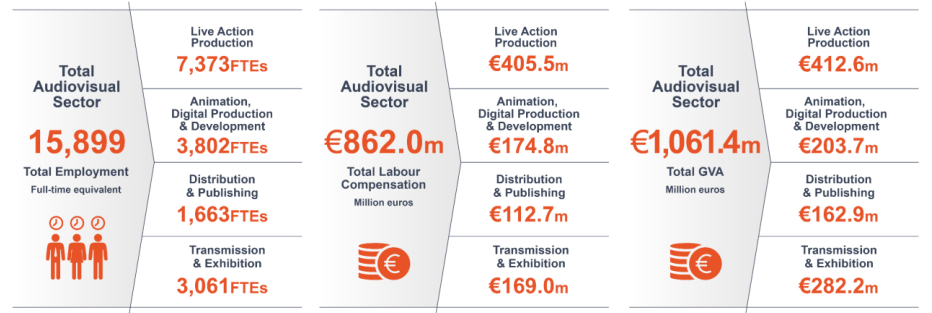
The Irish animation industry has long been a creative cornerstone of Ireland’s vibrant film industry, and has witnessed substantial growth in the last decade. It is an integral and important component of Ireland’s digital and creative economy, employing 1,600 full-time staff.
Just 10 years ago, there were only 70 people in full-time employment in animation in Ireland and in this short space of time, there are now over 20 times that number working in the sector.
The screen industry relies on skilled people across all sub-sectors and departments, at all levels, from entry level to experienced.
It is important to note that while the screen sector is inherently a creative industry, not all roles are creative. A career in the screen industry is not only those who want to become directors, producers, screenwriters or actors. The screen industry needs accountants, riggers, production office staff like co-ordinators and production managers, hairdressers, make-up artists and many more roles that all work to make a production happen.
Here are a few examples of the various kinds of skills and interests that are suitable for particular roles:
Audiovisual
The demand for talent: shortages in senior roles across production departments Currently, departments facing skills shortages and demand in live action production, were in the production management, development and post-production departments. Importantly, in terms of seniority levels, skills gaps were found in key head of department (HOD) roles across departments, Economic and Skills Analysis of the Audiovisual Sector in the Republic of Ireland 6 indicating shortages at senior levels. Critical skill gaps were identified in specialised roles, such as production accounting and editing, as well as a strong need for creative talent, particularly writers and directors experienced in Irish language production.
The demand for technical roles was coupled with a need for multi-skilled professionals who can navigate various production types, highlighting the importance of versatility in the workforce. There is increasing demand for a combination of technical and general skills Stakeholders also identified key skills development areas that they felt were important to address learning priorities.
These areas included business management, accounting, marketing and promotion, among other more technical areas. The integration of data analytics and artificial intelligence (AI) into content creation further underscored the necessity for ongoing professional development to keep pace with technological advancements.
Soft skills such as communication, teamwork, and adaptability were identified as crucial competencies necessary for success in an industry characterised by project-based work and rapid change. Increasingly, stakeholders noted the need for increased skills development opportunities in the regions, outside sector hubs of Dublin and Wicklo
Animation
According to the most recent figures available, Irish studios employ more than two thousand staff. The ambition is to double the value of the sector again in the next five years and to increase the numbers working in the industry by up to 50%. There is a good regional spread of members with numerous studios in Dublin, regional hubs in Galway and Kilkenny, as well as individual studios in Clare, Cork, Louth, Offaly and Roscommon. Learn more about Skills gaps in the animation sector in the report below: